A Sign From Thomas

Darlene Montgomery - For Blog

It can happen that we become so caught up in our grief that we fail to see the signs our loved ones are sending to show us they are just fine in their new existences. Darlene tells a story of how a case like this played out after her dear friend passed away.

By Darlene Montgomery

Thomas Drayton was my best friend. We’d met during the breakup of significant relationships in both our lives. We’d both had a powerful spiritual experience and been left wandering and wondering about our direction. We found each other in San Francisco at a seminar for our church, ECKANKAR, and had been friends ever since.

To say that Thomas was an enigma would fall short of the wonders of his character. To describe Thomas, I’ll start with his one eye. He was blinded as a teen when someone had thrown a rock up in the air and it landed on his eye. So Thomas often wore a patch. But he saw more with his one eye then most saw with two. Thomas was a mystery to all, except his closet friends; and even we, sometimes, had trouble penetrating the mystique of his profoundly creative, spiritual character.

Throughout our years of friendship, Thomas and I traveled together, spent time on the phone, went to movies, cried, laughed, fought and shared our writing. Mostly I listened to the reams and reams of poetry my friend composed while he lay awake night after night. You see, Thomas hardly ever slept more than three or four hours. He had several books of poetry published throughout the years, all of a profound and spiritual nature.

Thomas was struck down by cancer suddenly one summer. It came on so quickly and it took him all too fast. Fortunately, I was able to say goodbye. One evening just before he died, I visited him in the hospital. I entered the room to find Thomas looking gaunt, with the signs of death on his face and body. His spirit, though, filled the room with light and a profound sense of God. Thomas became even more of the person he was as he surrendered his spirit to the divine.

That night, I found myself feeling awkward, as I sat in shock, staring at his face which had shrunk in the four days since I last saw him. I knew that he would be leaving this earth very soon. He asked me, “Are you shocked? Do I look like Lily did before she died?” A friend of mine had died just two weeks earlier from a long battle with cancer.

“Yes.” I said, and stumbled to ask him, “Will you give me a …”

“Sign?” he filled in. “Yes.”

I had to leave town for few days to attend a conference. I was filled with angst—even though, in my religion, we refer to death as “translation” because we see it as a transition from one state of consciousness to another. Even so, I wondered: What if Thomas translated before I returned? I didn’t think I could deal with that.

But he managed to hang on another week. I was able to see him one last time, although he was past being able to communicate by then. Thomas left his physical form on October 24, 2007 in the late afternoon, surrounded by family.

This was my first great loss of someone close to me through death (or translation) and I went into a profound state of shock. I waited for the promised sign. Days passed. A week or more came and went.

“I guess I’m not going to get a sign,” I thought.

A few weeks after that, I stumbled into the living room of my apartment after waking one morning. Lying on top of the small entrance table was a ticket stub from a play that my daughter had dropped. It had been there since the night Thomas translated, but in my grief, I’d left it, never bothering to pick it up. I reached down and started to actually read the words on the ticket.

Crazy for You,” it said. In the left-hand corner was the word Drayton.

 Crazy for you. My eyes welled up with tears as I realized Thomas had given me my sign weeks ago, if only I’d noticed: The play had been produced by Drayton Productions, on Drayton Avenue in—yes—the Town of Drayton! The date of the play: October 24, 2007, the evening Thomas left this world for his journey to the heavens beyond.

So much like Thomas to slip that one by me. I laughed then, for the first time in a while.

I’ve kept the ticket. I love you Thomas. I’m crazy for you, too.

Darlene Montgomery is author of the Conscious Women Conscious Lives Series

And Dream Yourself Awake: One Woman’s Journey to Discover Her Life Mission through Dreams. You can find out more about her work here. http://www.lifedreams.org/
 

A Presaging Experience Gives Ben Strength for His Family

Ben Burchert - FB story adapted for Blog

This story first appeared on one of our early Facebook posts.

Sometimes we receive assurance that our loved-ones live on after they have left their physical bodies; perhaps, in a dream or an encounter with a symbol that we know is meant just for us. Other times, if we are open, we can be given reassurance before we even learn they are gone. That is what happened to Ben one late summer day in 1985.

Ben, his wife and young children had recently moved back to Ontario following a remote posting with the Canadian Armed Forces. They were delighted to be in the embrace of their extended family again. Ben was particularly close to his uncle, whom they learned upon their return had an ailing heart that would require surgery.

One day soon after reuniting with his uncle, Ben was strolling to work in a particularly beautiful area, delighting in the beautiful day, the lovely view and in his gratitude for being reunited with his family. Here’s how Ben tells what happened next:

“As the sun warmed my face, I became aware that my heart had opened. Just then, I sensed a great lightness approach at lightning speed…and embrace me! Suddenly I was awash with the vision, smell and energy of my uncle. (It) rushed through me like a bright light with an enthusiasm containing…feelings of surprise, elation, love and happiness. As I processed these shining impressions (and) this wonderful energy, I continued on my way.”

Back at work, Ben allowed the experience to fade from his mind. Later that day, during a class he was teaching, his sergeant came to inform him that his uncle had died and that his family needed him.

“The remorse I felt was for the loss that my family was feeling,” says Ben. But, for him, “The messages I received during my Uncle’s departing embrace showed the way to freedom from sorrow and despair. This…enabled me to serve my family during the funeral with greater compassion, empathy and joy.”

Ben’s story demonstrates yet another way that we can be assured that death of the physical body is not the end—that the loving connections we have with our dear ones continue even after their bodies have expired.

If Ben’s story reminds you of an experience you’ve had, we would love to hear from you at The Meaning of Forever Project. You can join the conversation on Facebook, visit our website, and email us at themeaningofforever@gmail.com.

Please follow our blog and share it with your friends.


Can the Departed Share Jokes With Us?

Klemp - Miss our dear ones

While an experience with a loved one who has passed on may be  profound, it may not necessarily be solemn. In this story, Lori writes about a light-hearted moment with her departed mother as she attempted to repair an important a household item:

“My mother and I were extremely close. I love and miss her dearly. I know she is never too far from me. She sends me signs all the time.

“I recall talking with her before she got really sick. She let me know that she was not afraid of dying. She told me that, when she was a little girl, she became quite ill and was pronounced dead briefly. She said death was not scary, it was peaceful and calming. I knew she was reassuring me that, when the time came, she would be fine.

“I asked that she send me a sign after death to let me know she was okay. She took on a mischievous grin and I quickly said, “Don’t you dare come as a ghost!” She laughed and assured me she wouldn’t. “I know you pay attention to your dreams,” she said, “so I’ll visit you there.”

“My mother visits me often, but dreams aren’t her only method. She had a wonderful sense of humour and continues to give us laughs long after her death. One of her favourite words was “toilet”. Don’t ask me why, it just was. She would say the word and laugh, then make you say it. She said it would just roll right off the tongue.

“One day, long after my mother’s passing, I had trouble with the toilet in my townhouse unit. Instead of calling maintenance, I decided to fix it myself. (My father was not a handy man at all, so Mom and I would often tackle repairs before calling in the experts.)

“This day, I was focused on the problem at hand, trying to figure out the issue and how I could repair it. Out of nowhere, I heard my mother’s voice: “TOILET!” it said. I started to chuckle. The voice came again. “Say it with me: TOILET!”

“I laughed. ‘Hi Mom! Look at me, I’m fixing my toilet! There I said it with you!’

“So, I was able to fix the toilet—and to enjoy an auditory visit with Mom at the same time.”


What We So Far Know of Heaven

What We So Far Know of Heaven

For millennia, we the living have known of heaven only what our scriptures and spiritual leaders told us. Conventional wisdom was that, once we crossed over, there was no coming back to tell about it. But, in recent decades, all that has changed. Now we have stories of near-death experiences, of children’s memories in times before they were born—of loved-ones who have passed away reaching out to reassure those they’ve left grieving behind.

So, what is heaven like?

In his popular book, Proof of Heaven, Dr. Eben Alexander tells of his experiences during the seven days he spent in a coma and tries to relate what it was like to be in the presence of God, whom he refers to as “Om”. Alexander has no compunction about claiming to have been in the presence of, and even in communication with, God because he says every one of us—every soul—has the capacity to do the same.

Alexander’s descriptions of heaven—or the “place” he visited while he was clinically dead—is not so much about a location with sensory detail as it is about consciousness.

“I never heard Om’s voice directly, nor saw Om’s face. It was as if Om spoke to me through thoughts that were like wave-walls rolling through me, rocking everything around me and showing that there is a deeper fabric of existence—a fabric that all of us are always part of, but which we’re generally not conscious of.”

Alexander returned to physical consciousness profoundly changed, with what he considers a duty to share his discoveries with others.

“I am especially eager to tell my story to the people who might have heard stories similar to mine before and wanted to believe them, but had not been able to fully do so,” he says in the introduction to his book.

In Memories of Heaven, Dr. Wayne W. Dyer and Dee Garnes collected vignettes shared by parents of small children who, in their childhood innocence, related memories of what it was like before they were born.

One mother wrote, simply, “My four-year-old used to talk about when he was in heaven before he was born, and when I asked him what it was like, he said it was all parks.”

A father was driving on the road with his three-year-old daughter when their conversation turned from the moon to heaven; so, he asked if she’d ever been to heaven. His daughter answered yes. The father said his own mommy was in heaven and that he was sorry his daughter never had a chance to meet her.

“Yes, I did,” said the daughter.

“What do you mean?” said her father.

“I saw her in heaven with God,” the little girl answered.

In our February 7, 2017, post Suzie wrote of a joyous reunion with her departed father and brother in a dream. They were happily farming the coconut plantation her father had only made a start at before he passed away.

“I believe a person brings his or her state of consciousness into the new world that they move into,” wrote Suzie. “Our aspirations are recorded in our transcendental selves and therefore are taken anywhere we go.”

In her book On Life After Death, Dr. Elizabeth Kübler-Ross wrote, “Dying is a human process in the same way that being born is a normal and all-human process.”

She wrote of her own experience, which she considered one of the stages in the process of crossing from this life to the next one:

“Having been born in Switzerland, I was allowed to cross a pass in the Alps covered with wild flowers. Everyone is met by the Heaven he or she imagined…”

In Spiritual Wisdom on Life After Death, Harold Klemp describes heaven this way:

“…As bright as the sunlight appears to our eyes, this physical world is a dark, small, mean place compared to the other worlds. You will see settings similar to those on earth, but larger and with a lot more light.

“There will be a lightness and spaciousness about the body that you wear there. Soul is once again wearing a body, but It is on a higher plane. It is so natural that generally you don’t give it a second thought. And you are always greeted by someone you know and love.”

Implicit in all of these descriptions is the value that knowledge of a life after death can add to our physical lives. Those who write of experiences with heaven see themselves as integral parts of something bigger, and the essence of that “something” is love.

Says Klemp: “For people who love truth and love God, it’s a smooth change. The key really is love.”

In his introduction to Imagine Heaven, John Burke, a former skeptic, says his studies of others’ near-death experiences have taught him to treasure his current life even more. And he adds this challenge:

“What if we became people who have a vision for the ultimate Life to come? …What if how you live really does matter to the life to come?”

The Meaning of Forever Project welcomes your stories of comforting experiences with loved ones who have passed on; or, of your own near-death experiences…encounters, perhaps, that have given you a glimpse of heaven.

For more information about The Meaning of Forever book project, please see our website (here), or visit our Facebook page (here). To send us a story or ask questions, please email themeaningofforever@gmail.com


A Mother’s Inspiration Uncovers a Daughter’s Hidden Talent

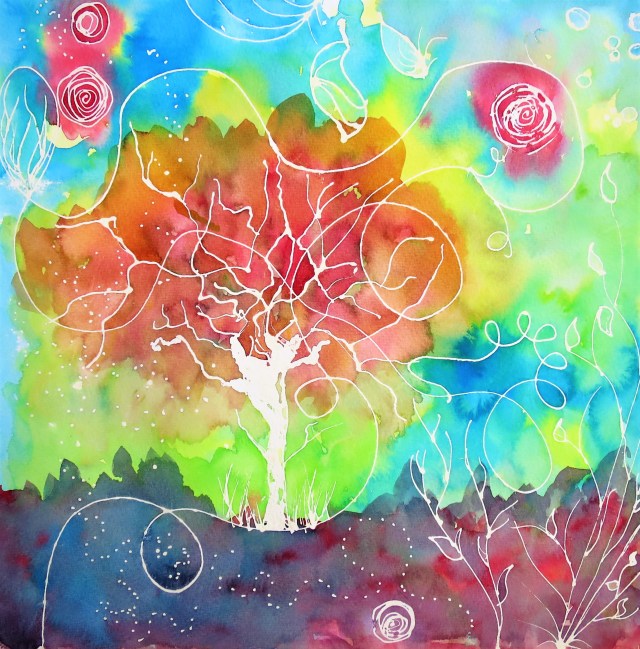
lena-montecalvo-art-whimsical-tree

Whimsical Tree © Lena Montecalvo

This week’s post is a repeat of one of our earliest posts, about how our loved ones can leave great gifts behind when they leave this physical body.

♥♥♥

Sometimes when loved-ones pass on—if only we open our hearts—we find they’ve left us gifts greater than anything we could have imagined. Here is a story of one such gift.

Lena has always felt there is more to life than we see with our eyes, so the possibility that her deceased parents might communicate their love to her, even after their deaths, has been easy to accept. As a young woman, she felt and smelled her father’s presence during her deepest sorrow after his passing. In later years, Lena has seen and heard the presence of her mother during some of her most difficult times.

But something Lena could not have predicted is the way her mother would help her make a new beginning and reveal a talent she did not even know she had.

“My mother was a talented artist who didn’t share her work widely. She was a little on the shy side and suffered depression in her later years. Painting water colours and folk art gave her great personal reward and comfort.”

After her mother passed away, Lena wrote her eulogy and concluded with words she’d found scribbled in one of her mother’s sketch books: “Mantra for new beginnings.” Then, needing to know something about her mother’s next journey, Lena consulted a set of rarely-used angel oracle cards.

“I said out loud: ‘Mom, if you want, and if you are able, please help me pull a card that will tell me you’re alright; that you are here with me.’”

Lena shuffled the deck and, “I pulled The Butterfly. I turned it over and read a comforting and completely fitting passage about ‘new beginnings’. It was clear: It was Mom.”

Later, she and her sisters sorted through their mother’s belongings as they prepared to sell her house and give away the things they could not use. For a reason Lena could not explain, she kept the art supplies.

“One night, I decided to try a tiny painting,” she says, and this led her in a direction she could never have predicted: “I had no idea I was able to paint!”

A few years afterward, “I have found I possess a definite and recognizable style, and it makes me happier than anything I have ever done.”

Lena is now an active participant in her local artistic community where she gives art classes and sells her own work. She also makes a few prints and cards of the water colours her mother left behind.

“I know for certain this comes from my mother’s inspiration. I feel her close when I pick up the brush,” says Lena. “It’s a perfect legacy to me.”

If you have an inspirational story to share about a comforting experience you have had with a loved one who has passed on, we would love to hear from you. Please contact us at themeaningofforever@gmail.com. You can find out more about our project on our Website and our Facebook page. If you like this story, please click “Follow” at the right of your screen and feel free to share with others.


An Elusive Blue Light Shows Sybil How Life Continues Through Birth, Death And Beyond

Sibyl Barbour - Blue Globe -

As far back as Sibyl can remember her father, a Presbyterian minister in Scotland during the 1940’s, told stories of suddenly seeing friends and relatives coming to say goodbye not long after they left this life. Always, he would say they were accompanied by a blue globe of light.

Sibyl longed to see this blue globe, but many years would pass before she did. In the meantime, she became a registered nurse, immigrated to Canada and began delivering babies at a hospital in Ontario. It was 1975 when that light finally appeared.

“Every time I welcomed a newborn baby into the world I became aware of the small blue globe of light that accompanied each baby at birth,” writes Sibyl. “My Dad, on the other hand, experienced the blue globe of light when his deceased friends came to say their goodbyes.”

So, she formed her own conclusion: “This blue light was present whether a human being was coming into this world or leaving it! I came to the realization that, regardless of faith or belief, a loving Divine Presence is always with us.”

More than a decade later, Sibyl made the sad journey home to Scotland to be with her mother who was dying of cancer. There, at her mother’s bedside, Sibyl saw that same blue globe—much larger this time and, although she experienced the agony of knowing her mother was about to pass from this world, she also felt “ecstasy knowing that this Divine Presence was there to lead her to her new home!”

A couple of months after her mother had passed away, Sibyl had three dreams in which she learned that her mother had a lovely home in the new world where she now lived. When Sibyl made her dream visits there, she was also able to visit her deceased brother.

“In the third dream I was shown how happy my Mom now was with her new life and friends. As I prepared to leave she reminded me in a kindly way that she was no longer my mother!

“This showed me that I needed to learn a certain amount of detachment and let my Mom get on with her new life.  I also knew that this bond of love that we shared in life would never die.”

Thank you, Sybil, for your wonderful story. For us at The Meaning of Forever Project, it illustrates three very important principles: 1. That each of us is accompanied by a Divine Presence whether or not we know it; 2. That, even though our loved ones may comfort us with their presence after they have left this life, there comes a time when they must continue to their next stage of unfolding as Soul, and it is important for us to let them go; and, 3. Even though we know this, we can also know that “this bond of love that we shared in life” will never die.

If you have a story about how you learned of the continuation of life, and how the love between Souls continues forever, please feel free to contact us: on Facebook, through our website, or by email at themeaningofforever@gmail.com

We would love to hear from you! You can follow our bi-weekly blog by clicking “Follow” to the right of your screen.


Whisper Receives a Seal of Approval from the Other Side

A Gift from Maggie

This post first appeared on The Power of Pets website maintained by Marybeth Haines. 

By Ruth Edgett

Sometimes in the world of humans and horses—if we’re lucky enough—we meet our horse of a lifetime. Ubetcha Maggie was that horse for me. I felt eternally twelve years old with her. Together we could run faster, go farther, have more adventures than either of us could ever do on our own.

Having begun life as a Thoroughbred racehorse, Maggie was 1,000 pounds of compressed energy, ready to explode at the least provocation. And she was my best friend. My road with Maggie, from timid purchaser to confident rider, had taken some bumps and curves but eight years into our relationship, Maggie and I had become a well-synchronized pair; we trusted each other absolutely. Maggie would even come to me in dreams. Once, as we were still sorting our relationship and I was learning a painful new meaning for the term “On again, off again”, Maggie appeared in a dream to say proudly, “I’m very fit!” to which I replied ruefully, “I know.”

Through dreams and inner experiences, I gradually realized that Maggie’s and my story may have had its start long before we met in this life. Perhaps we had been together in previous lives, too, and this one was a chance for two souls who loved each other to be together once again. It was that kind of love that saw us through Maggie’s last days, because I had a knowing that in this life—perhaps unlike past ones—it was my job to see her out. And I did. I was there the frigid January midnight that Maggie drew her last breaths and collapsed on the floor of her stall after a valiant battle with pneumonia.

With the physical part of Maggie gone, I felt like taking a rest from horses. Responsibility for another horse, and all the commitment and expense that entailed was not something I wanted to jump right back into. Yet, friends convinced me to continue riding, and there were lots of horses who needed riders. In fact, one lived right next door.

A family had moved into the horse farm nearby only the year previously. By the time of Maggie’s death, my new neighbour—we’ll call her Alice—had bought a horse for herself but learned through painful trial and error that Whisper was not for her. In the spring following Maggie’s passage, Alice offered to let me ride Whisper occasionally.

She was an entirely different type of horse than Maggie. Where Maggie was sleek and elegant, Whisper was big-boned and solid; where Maggie was excitable and explosive, Whisper was sensible and moved with deliberation; where riding Maggie felt a like floating, I could feel every jarring step Whisper took. Still, my first time on Whisper’s back felt right. It seemed as though she was asking, “how can I work with you to make our ride a good one?” Eventually, my friends began to comment on how well Whisper and I got along. I would respond, “She’s not Maggie, but she’s a good horse.”

One day, as I was grooming Whisper after a ride with Alice, we fell into a conversation. She loved Whisper very much but knew she would never feel confident enough to ride her again. Also, she felt Whisper was too fine a horse to be left standing in the pasture for the rest of her life. Although it hurt to give her up, she knew Whisper needed another owner. Alice said she’d talked it over with her husband and, “We’d almost be willing to give her to you,” she said. “A case of beer and a Toonie would probably do it.”

As she said this, I could feel a kind of silent pull from Whisper, as though she was pleading, “Please be my person…”

Still, I told Alice, “It’s too soon since Maggie. I need time.”

Soon after that conversation, I had a dream. I was in a pasture with all of Alice’s horses and someone was handing out treats, which the horses were taking turns to accept. I was standing beside Whisper, but Maggie was there, too. When it came time for Maggie to take her treat, she stepped forward like the others. But, instead of eating the gift she was given, she brought it to me. I remember thinking inside the dream, “How beautiful that she’s giving me this treat. It’s because she loves me.”

As I awoke, I knew what it meant: Maggie was giving me the “gift” of Whisper, and it was a gift of love. Soon after that, I delivered a case of beer and a two-dollar coin to Alice in exchange for Whisper’s bill of sale. That was eight years ago. Whisper is not Maggie, but I do not want her to be. Whisper is Whisper and what a wonderful partner she is. Together we run faster, go farther, and have more adventures than either of us could ever do on our own. I know, now, that I have been truly blessed with my second “horse of a lifetime”—and I know that Maggie approves.

With Whisper - March 2011
Whisper and Ruth

On Dying and Living to Tell About It

Joan's Blog on Near Death

When we share stories by contributors to The Meaning of Forever book project, love shows up as one of the abiding qualities in the variety of experiences people have with their departed loved ones. This seems to be true of near-death experiences as well, and as Dr. Joan Olinger writes, that feeling of transcendent love and the knowledge that life continues after expiration of the physical body are two lasting benefits cited by those who have died and been brought back to life.

Because near-death experiences are one more way to show that life continues, regardless of whether we have a physical container, The Meaning of Forever Project is also seeking stories about these experiences. Read Joan’s blog below to see how NDE’s can be a source of great comfort in grief and a means for releasing fear.


By Dr. Joan Olinger

What would it be like if you knew for certain that you do not die when your physical body dies; that, Instead, you continue as yourself, with your individuality intact?

We are so fortunate to be living in an age when people can be brought back to life, even after they are clinically dead; that is, when their heart stops beating and they stop breathing. Many of these people have told of their experiences in the time between their physical deaths and their resuscitation.

When my Father passed on a few years ago, I was deeply distressed. My distress was relieved to a great extent, however, when my brother told me that Dad once had a near-death experience after a heart attack. From then on, he was not afraid to die. Knowing of this occurrence gave me great comfort. It was proof that the essential part of my father—some call this soul—continues independently of his physical existence. My brother said our dad’s story helped him lose some of his own fear of death.

In 1975, in his groundbreaking book called Life After Life, Dr. Raymond Moody wrote of accounts by people who had been brought back to life, and he coined the term “near-death experience” (NDE). I read Dr. Moody’s book as a young woman and became very interested in NDE’s (See my May 11, 2017, blog about why The Meaning of Forever Project is so important to me).

About 15 years after reading Dr. Moody’s first book, I met a patient in her forties who had been pronounced dead and been resuscitated. Her near-death experience transformed her life. Having not done anything artistic since Grade 8, she became an artist and a poet, and won contests for her creative work. When I asked what happened during her near-death experience, she said it was very hard to put into words. Then she said she had gone through a tunnel, met with a brilliant, loving light, and that she was “in love” the way she and I were sitting in that room. I took this to mean that she had felt totally surrounded by love.

Dr. Pim van Lommel, a Dutch cardiologist and one of today’s most prominent scientific researchers of near-death experiences, is a contributor to a book called Surviving Death by Leslie Kean. In that book, Dr. van Lommel writes: “The NDE (near-death experience) is almost always transformational, causing enhanced intuitive sensitivity, profound insights and re-evaluations of life, and a loss of a fear of death.”

In his book God and the Afterlife, Dr. Jeffrey Long writes that near-death experiences often include the following: a) an awareness that the experiencer is no longer in their physical body, b) heightened senses, c) going through a tunnel, d) seeing a brilliant light,  e) intense and usually positive emotions, f) going to heaven or otherworldly realms, g) meeting with deceased relatives, friends or mystical beings, h) a review of the person’s life, i) learning special knowledge; and, j) returning to the physical body. He gathered this information scientifically through a questionnaire administered by the Near-Death Experience Research Foundation, which he established.

In the process of working on The Meaning of Forever Project, I have had a chance to read many books, watch some incredible documentaries and talk with several friends who have had near-death experiences. Through this process, I too have lost my fear of death, and I take comfort in knowing that departed loved ones are just fine and enjoying their next existence.

Later, in another blog, I will provide an overview of the books listed below:

John Burke, Imagine Heaven. (Grand Rapids, Michigan: Baker Books, 2015)

Jeffery Long and Paul Perry. Evidence of the Afterlife: The Science of Near-Death Experiences (New York: Harper Collins, 2009)

Jeffery Long and Paul Perry. God and the Afterlife, (New York:  Harper Collins, 2016)

Leslie Kean. Surviving Death: A journalist investigates evidence for an afterlife, (New York: Crown Archetype, 2017)

Pim van Lommel. Consciousness Beyond Life: The Science of the Near-Death Experience (New York: Harper Collins, 2010)

If you’ve had a near-death experience that has helped you understand the continuation of life, or that has provided solace as you grieve the passing of a loved one, The Meaning of Forever Project would like to hear from you at themeaningofforever@gmail.com. You can find out more about our project on Facebook (here) or our web site (here)

Disclaimer: The books listed here do not necessarily represent the beliefs or opinions of The Meaning of Forever Project.

If Death is Not Really Death, What is There to Fear?

Pitstick - Death is a transition

DISCLAIMER: While The Meaning of Forever Project has taken an interest in the work of Dr. Mark Pitstick and his book Soul Proof; while we have posted stories of comfort by people who claim the ability to communicate with the departed, The Meaning of Forever Project does not endorse any type of mediumship, or other attempt to communicate with the dead. The purpose of The Meaning of Forever Project is to show those who are bereaved that they can let their loved ones go, knowing they continue to thrive in another type of existence. We do not seek to initiate contact with souls once they have moved on from this physical life.

When we began The Meaning of Forever Project to gather stories about comforting experiences with loved ones who have passed on, we had no idea how much had been written on the subject already, or on the larger question of life after death. Dr. Mark Pitstick’s book, Soul Proof: Compelling Evidence That No One Really Dies and How That Benefits You Now, caught our attention almost right away.

Pitstick, who says he has sat with many dying people, and that his credentials include graduate training in theology, clinical psychology and chiropractic health care, takes an evidence-based approach to the idea that life and consciousness continues independently of the physical body. Initially a skeptic who had seen one too many deaths he could not make sense of, Pitstick set out to answer, in a logically defensible manner, the question that has been with all of us since time immemorial: What happens after we die?

His conclusion is this: “Life is, most fundamentally, comprised of energy and light that is ever-changing, but never-ending. And that’s what you really are—an indestructible being of energy, light, consciousness, spirit.”

For Pitstick, knowledge that life and love continue after death of the physical body not only frees him from the sometimes-overpowering weight of grief over lost loved ones, it also enables him to live his life more fully because he is no longer afraid of dying.

This concept of freedom from fear is the underlying motivator of The Meaning of Forever Project. While the outward focus of our book will be on taking comfort in knowledge that our loved ones continue after physical death, we know that by taking this wisdom to heart, we can also release the innate fear of our own eventual deaths. And, as Pitstick says, this is when we find the freedom to truly live.

In the weeks to follow, Joan will be reviewing and summarizing a number of books in which people who have had near-death experiences describe other-worldly encounters of great beauty and comfort–and, how those experiences have affected the way they have chosen to live the rest of their physical lives.

In that spirit, The Meaning of Forever Project is also accepting stories about near-death experiences, particularly those that can show how the experiencer’s view of grief has changed because of it.

You can find out more about Dr. Mark Pitstick and his book Soul Proof on his website.

For more about the ever-growing list of materials Joan and Ruth are compiling, please visit The Meaning of Forever Project Home and Resources pages.

To stay up to date on our latest posts, please “like” our Facebook page or follow our Blog by clicking the “Follow” button to the right of this post.

Two Perspectives on Life After Death: The Spiritual and the Journalistic


You are Soul

If we accept the above as true, it’s not a stretch to believe that a loved-one who has passed into that next “stage of experience” continues to love those left behind and may, possibly, try to let them know.

Contributors to The Meaning of Forever Project have experienced just that: feelings of love from the person, or animal, who has died. They have been visited in dreams, in visions, through sounds, the appearance of articles that hold special meaning, and in many other ways. Some have had near-death experiences that, by showing how life continues after death, help them deal with the loss of those close to them.

In our previous post, a dream experience allowed a grieving mother to hold her daughter once again. Another contributor wrote of feeling both ecstasy and grief at the time of her mother’s passing; one described how her much-loved dog returned to her in a new body; yet another described how sounds and discovery of small articles demonstrated that her grandparents and her mother continued to be with her long after their physical bodies were gone.

The common thread in all these experiences is love, a love that lives beyond time and space, beyond the physical bodies of those who share it.

Harold Klemp writes that soul is the essential, animating part of every individual, that this essence within each of us can never die, and that its defining nature is love.

“…Soul, knowing of its divine nature, sees beyond the ends of eternity and knows It can never be extinguished like a candle’s flame,” he writes in Spiritual Wisdom on Life After Death.

 In her book Surviving Death, journalist Leslie Kean applied objectivity and scientific method to her research into the possibility of an afterlife. Here’s what she says in her introduction:

“While exploring the evidence for an afterlife, I witnessed some unbelievable things that are not supposed to be possible in our material world. Yet they were unavoidably and undeniably real. Despite my initial doubt, I came to realize that there are still aspects of Nature that are neither understood nor accepted, even though their reality has profound implications for understanding the true breadth of the human psyche and its possible continuity after death.”

Kean documents what she calls “after death  communications” (ADCs) in the form of “dream visits”, moving forms or apparitions, effects on electrical items, lights, voices, sounds and smells. She says these ADCs sometimes come as a shock because they are often unasked for and may occur for people who would never consider such things possible. Kean acknowledges that many people—including herself—are uncomfortable talking about these phenomena.

“Because they come and go quickly, and are rarely documented, ADCs are not evidential in a strict sense. Yet, these experiences can be the most potentially life-changing link to belief in survival for their recipients, because the messages can be so profoundly personal and specific,” writes Kean.

You can find both Kean’s and Klemp’s books listed on the Resources Page of The Meaning of Forever website.

So, perhaps that the dream you had—or the fleeting image you saw, the sound of a voice long gone from this earth, or the feeling your dear one was there beside you—was not just your mind playing tricks on you. It may be that it was your loved one saying in a manner meant specially for you, “I’m fine in my new life, and I love you as I always have.”

At The Meaning of Forever Project, we value and honour any experience you may have had with a departed loved one that has made you feel loved and helped you move forward in your grief. If you would like to share that experience with us, please do at themeaningofforever@gmail.com

See our website, Facebook page and previous blog posts to find out more about The Meaning of Forever book project.