If you ask Renee Moor what inspired her to found Journey Home, a non-profit community service dedicated to “empowered living and dying,” she can list many ways her own life has prepared her. It began with proving herself after being told, as a late-developing child, that the best she could hope for was assisted living; it continued through two decades as a behavioural therapist helping parents cope with autism diagnoses for their children; it carried on through her practices as a Buddhism psychotherapist, a student and instructor of yoga, and as a master in the art of reiki healing. But even these, compounded by the deaths of her father and husband within 18 months of each other, don’t complete the story.
The experiences that locked into place the final piece of Renee’s life puzzle came in her dreams.
“My dad just kept coming and coming in my dreams and guiding me,” says Renee of the years after her father’s death. Seated in the space she has created for people to meet, share, and learn from each other as they go through their individual experiences with death and dying, Renee is relaxed and confident. “In all my twists and turns of life,” she says, “I found my way.”
Already a reiki master and busy yoga instructor at the onset of the Covid pandemic, Renee found herself in the same situation as many: cut off from her livelihood and society in general. It was in those dark days alone at home, with the time to fully process the loss of those she loved, that she began to thoroughly embrace the practices of meditation embedded in both yoga and Buddhism. Then came a series of visions and vivid dreams that inspired her to train as a death doula.
Much like a childbirth doula, a death doula supports a dying person and their family through the dying process, first by helping them gain information and insight, by connecting them with available medical and community supports, and finally by helping make the last moments a positive experience.
“I saw a huge gap in services, because doctors and nurses focus on treatment; funeral homes and crematoriums focus on the remains—but, there’s no one there for the death.”
In contrast, says Renee, her father showed his family that death can be beautiful. “He made his dying about us and we made his dying about him.
“He knew he had six months to live after his diagnosis of pancreatic cancer, and after his fear, anger and sadness, he chose acceptance and love. Each day he showed up to life as fully as he could, both on his good days and his bad days.
“We as a family have beautiful, funny and grateful memories of the season my dad died. After his dying, I wanted everyone to experience a death like this, but life had other plans for me then.”
As time went on, though, says Renee, “He kept coming to me in dreams and meditations. He would offer the most profound philosophies, and now I see he was preparing me. As I opened my heart and mind, his message became clearer to me.”
Renee looks back on three dreams as pivotal to placing her where she is now. One came not long after her father’s death, where she saw him striding down a rocky slope with arms wide open. “Don’t worry about me,” he called to her. “I’m in a better place.”
Some time later, as Renee’s life went through more changes and she began to focus her energy on services for those touched by death and dying, her father appeared in another dream. He asked her to meet him on Dundas Street, which is a stretch of highway that connects the city of Hamilton in Ontario, Canada, with the city of Toronto, about 65-kilometres away. For Renee at the time, this location was symbolic of her life adventures up until then.
“… [N]ow I see he was preparing me. As I opened my heart and mind, his message became clearer …”
As she walked down the street to meet him, a large building seemingly made of white lights guided her toward him. Again, her father held his arms open to her and she ran to him. As they met, Renee’s car keys caught in the back of the sweater he was wearing. As her older sister helped disentangle them, Renee’s father said, “Don’t worry. We all get a little lost sometimes, but now you’ve found your way.”
Soon after that dream, Renee became aware of a location for rent in a small town next door to Hamilton. Surveying the bright, high-ceilinged space inside a large heritage building in the centre of the community, Renee knew this was the perfect location for Journey Home. As she stepped back outside and looked toward the main street, she understood the true force of that dream: Journey Home would be located in a town called Dundas.
Not only that. As a student and instructor of yoga, Renee knew that the entanglement at the back of her father’s neck had significance. It sits opposite the throat chakra which represents how we express ourselves, how we listen and how we communicate. For Renee, Journey Home is more than a suite of services for an underserved segment of the population; Journey Home is her means of expression.
All the same, championing an organization whose services centre around death and dying is a daunting prospect. While people who work in hospice care and a handful of medical professionals understand the value she brings to her community, the majority of health practitioners have not been so receptive. Despite having established a board of directors, together with a group of supporters and co-workers to help ensure Journey Home’s success, there are days when she feels very alone.
But, says Renee, her father has an answer for that, too. In another dream, she came upon him carrying large sacks of flour up a stairway. “I’ll do the heavy lifting,” he told her. “You just keep baking the bread.”
Editor’s Note: Until recently, the retail space next door to Journey Home was occupied by a thriving business called The Village Bakery.
The Meaning of Forever Project continues to accept stories of comforting experiences with loved ones who have passed on, and of near-death experiences that have helped to show the continuation of life beyond the physical body. You can email your story to us atthemeaningofforever@gmail.com and you can find more about our project on our Facebook page, and our Meaning of Forever Website.
David was twenty-nine years old when his father died at home of cancer and the undertakers came.“You might not want to watch this,” he was told as they brought in the gurney. David isn’t sure where the words came from but he replied, “That is not my Dad, only his body.”
It was the beginning of a decades-long search for the answers to questions that ran deeper than, “Where do we go when we die?”
Raised in a Roman Catholic home, David struggled with the idea that his father’s body would someday be resurrected. He kept in his heart the priest’s explanation at the funeral that his Dad was a soul created by God and was, therefore, eternal. Still, he couldn’t help but wonder, “Why would my Dad, as eternal soul, want to come back into a body that was messed up?”
Today he’s convinced he’s found the answers to his questions.
David had other questions that priests couldn’t answer satisfactorily; like: “Is there a meaning to Life? What happens to the love given to others throughout the lifetime of an individual that has passed? And, more importantly, where did that love come from?”
Eventually David left the church and became what he calls “a seeker”. Today, he’s convinced he’s found the answers to his questions, and it all comes back to that idea of soul and his father being more than a body on a gurney. Each of us is soul with free will and conscious of ourselves, he says. Further, we are unique creations of Divine Spirit, which is an aspect of God. We exist because God loves us.
“I began to get a glimmer of understanding that soul manifests God’s love through its relationship with Divine Spirit.” In David’s lexicon, Divine Spirit is another term for Holy Spirit, or the creative energy that brought us into existence. “It is through the physical form that soul uniquely manifests that light of love here on this earth,” he says.
David built on this concept when asked to write his mother’s eulogy. He tried out the idea that, as souls, we come into this world with only love to give, we give that love throughout our lives and take that refined ability with us when our physical bodies die.
He tried out the idea that, as souls, we come into this world with only love to give…
“I posed a question: People remember how we each gave out love; that is why we are here to honor my Mom. So, is it our sole purpose here on earth to better learn to give out God’s love?”
And, he took the idea further: “Maybe it is to recognize God’s guiding hand in this world and help Him make it a better place by allowing His love to shine through each of us.”
David believes evidence of our creator is all around us in the form of light and sound—the fundamental energies that make up our existence.
“Throughout our lives, as each of us as soul refines our ability to give and receive love—and as the light passes through soul—the resulting vibrations resonate on this earth as well,” says David. “This is why we sometimes feel relaxed around certain individuals we meet. Their vibrations are compatible, or in alignment, with our own.”
David believes it was that compatibility which allowed him to see his mother in a dream as she gradually became comfortable with the next world while still in this one. In his dream, he saw that, prior to her death, she passed nightly into the next world, then returned to her body. This made her transition easier when her time came.
“All I could do was give love, melding my memories of Mary Lou within the flow of Spirit and letting them go.”
More recently since the passing of his sister, David has found himself applying all of what he’s learned—but the learning isn’t finished.
“Since I understood that we are all connected by Divine Spirit, I asked my spiritual guide to show me how the soul that was Mary Lou is doing.” he writes. At first, he was taken aback at the reply: “Don’t interfere.”
Yet, he trusted his inner guide and accepted the advice. “All I could do was give love, melding my memories of Mary Lou within the flow of Spirit and letting them go,” he says.
“I had been expecting to have a dream experience, or to see her inwardly somehow. Not being able to do that was very hard to deal with, but I felt a strong reassurance from my inner master.”
Still, he felt hurt, “until I became aware of Divine Spirit filling the void with God’s love. I know my memories of Mary Lou will always be within me as soul, and those memories of her will add their own uniqueness to the light that shines through me into the world.”
David’s written poetry for his mother, his late cousin, and for his sister.
One way David has found to fill the emotional gap left by the physical absence of his departed loved ones is to relive heartwarming memories, then put them down on paper, either in story or poetic form. He feels that most of us can do the same, by finding a quiet place to open our hearts to memories of our loved ones. Using this method, David’s written poetry for his mother, his late cousin, and for his sister. Here’s an example:
Mary Lou
After struggling throughout her life with many health woes,
Sensing that her time on this earth was coming to a close
My sister was led to comment on a recent day,
“Nobody knows when, but everyone dies someday.”
What did we say to the one who has passed from this Earth,
Stuck in the middle of us and a survivor from birth?
What memories of the Soul we knew as Mary Lou?
Remember the feeling of her love given to each of you.
Love, that invisible and unbreakable strand that binds us all,
Guiding us home while listening to God’s beckoning call.
Her body ravaged by cancer is now in its final resting place,
Look deep into your hearts and see her in God’s loving embrace.
The Meaning of Forever Project continues to accept stories of comforting experiences with loved ones who have passed on, and of near-death experiences that have helped to show the continuation of life beyond the physical body. You can email your story to us atthemeaningofforever@gmail.com and you can find more about our project on our Facebook page, and our Meaning of Forever Website.
When someone says, “I will love you forever,” what do they really mean? Will they literally “love you forever,” even though you both know the human being speaking those words will not–cannot–be with you forever?
At The Meaning of Forever Project, we have a theory: That when two souls truly love each other, their love does last forever, beyond the life of one physical body–beyond (if you accept the idea of reincarnation) the life of many physical bodies. The stories you can read on our blog back this up (click here).
Your story may be like one of them, or it may be about a different experience entirely. But if it has reassured you that your loved one (human or animal) continues, even after physical death, please send it to us at themeaningofforever@gmail.com.
If you don’t consider yourself a writer, don’t worry, just write from your heart. We’ll work with you on the finer points of language and construction to shape it into a post that conveys exactly what you mean. We won’t publish your story until you are completely happy with it and give your okay.
Please join the discussion. Drop us a line at themeaningofforever@gmail.com Your experience may bring hope and comfort to others, just as it has to you.
It’s been a long time since you’ve seen a new post on The Meaning of Forever Blog, but I had to step back because my husband was dying and he needed me. Now that I’ve retaken level ground, the intention is to begin posting regularly once again. We’ll start with my story.
The apparent irony was not lost on me; that the person whose blogs touted an antidote to the pain of loss would be told a year-and-a-half into her project that she was heading for a heart-breaking loss of her own. But God wasn’t playing a cruel joke; It was handing me a gift. Stories of love from people around the world—with widely-varied lives and beliefs—let me focus on the positive, and to find reassurance in the experiences of others. When I needed it most, these stories confirmed what my project partner Joan and I weren’t alone in our assertion: Love truly does last forever.
Scott’s cancer diagnosis came in July of 2017, and only a few months later we learned it had already spread to his lymphatic system. There would be no cure, only treatments to hold off the inevitable. We knew three things that helped us accept this:
The loving force that created us works always for our spiritual good, no matter how that looks to us;
Before we entered these bodies at birth, we agreed to undergo experiences in this life that would take us toward that good, whether or not we remembered; and,
That everything in the universes of Divine Spirit is in its rightful place.
From diagnosis onward, we knew this was not the end for Scott; rather, it was the beginning of a new spiritual passage. We had no idea where the road would lead us, but we trusted there was purpose in the journey. We focused our energy on living the best life we could, while we could.
As his final days neared in early 2022, Scott would wake sometimes from a doze seemingly in the midst of a conversation. This signalled he was moving between worlds, preparing for his final transition. We joked about it, how he got a kick out of switching from one state to the other, how he would surprise me at times with a sudden exclamation to some being in his other world. I asked if he knew where he was going, and he said he’d been shown, that he liked the place. As we talked about his leaving and me being left behind he assured me, in his gentlest voice, that the length of time until we’re together again—when it happens—will seem “like the blink of an eye.”
We’ll be together again “In the blink of an eye.”
Scott’s final thirty-six hours were traumatic for both of us. It became impossible for him to take in enough oxygen using the prescribed at-home devices. After a harrowing night, he agreed to be taken by ambulance to the hospital emergency, where medical staff managed to stabilize him for a few hours—long enough for me to go home and get some sleep. But it didn’t last and I was called back, this time to accompany him to the Intensive Care Unit where we could say our final good-byes in private.
But we never got to do that. While I waited outside and the nurses settled him into his ICU bed, Scott left his physical body for the last time—just as they rushed me to him. I came upon him sitting upright, eyes staring, one hand raised as if hailing someone, heart already stopped. The nurses let me stay as long as I wanted, to hold his hand while his colour and warmth drained away, and to accustom myself to the fact his body was truly dead. I felt both cheated and guilty.
For all the attention we’d placed on bringing our best selves to the effort; for all our resolve to walk this last stretch of road together; for all the emergencies and near-misses; for all his determination to remain in his physical body as long as he possibly could—when Scott’s final moment came, I missed it.
Why didn’t I just stay with him all day? But we’d both been awake nearly thirty hours when I left him that last afternoon, and there was nowhere for me to rest. His room in the ER was barely big enough to hold a bed and the equipment to keep him breathing. There was one rigid, armless chair for me, which the doctors and nurses had to squeeze past to do their vital work.
“For all our resolve to walk this last stretch of road together…when Scott’s final moment came, I missed it.”
Part of our adjustment two years into Scott’s illness in 2019 was to sell the beautiful home we’d built on a magical property in the country. Scott was a gardener. He loved to plant things, to watch them grow and nurture them through their life cycles. He was with them before the first sign of shoots in spring until snow covered the ground in winter. He loved brightly coloured flowers and adopted reds and yellows as his theme. He envisioned our gardens as the house went up, and arranged them so there were special views from the rooms we used the most, ensuring there was always something in bloom. Later, still a gardener at heart when we’d moved to town, he arranged for delivery of fresh flowers every week with a card addressed to me.
It may have been the morning of, or a few days after I’d come home a widow exhausted and numb, that I saw this just before waking: A magnificent tree, tall and full, with giant trumpet-shaped blossoms in brilliant red and yellow, more vivid and fantastical than anything of this world. I knew it was Scott showing me a glimpse of his new home and saying all was as it should be, that I hadn’t let him down.
These events happened more than a year-and-a-half ago. When I look back on the months between, it’s hard to believe how much has happened since then, how much my life has changed and how many steps I’ve already taken to move forward. But earlier this year, as winter gave way to spring and the March 26 anniversary of Scott’s passing neared, the trauma of those last weeks came crashing back. As did some of our conversation in his final days.
When we got around to talking about funeral arrangements—which we left far too late, neither of us wanting to seem like we were rushing the end—I asked Scott what to do with his ashes. “I don’t care,” he said. “Just don’t keep them.”
“I asked Scott what to do with his ashes. ‘I don’t care,’ he said. ‘Just don’t keep them.'”
I knew what he meant. He didn’t want me so attached to him that I couldn’t get on with the rest of my life or allow him to be fully freed of his. I agreed but added, “I’m going to need you to hang around for the first year, though, just to make sure I’m okay.”
As the one-year mark loomed closer, I became increasingly anxious about what to do with those ashes—and whether I’d actually be able to let them go. I began to wonder what it would be like once Scott’s first-year promise expired. He prided himself on being a man of his word—and on being punctual. He expected the same of others, including me, though I often fell short on punctuality. All the same, I knew I needed to follow through on his wishes. After much consideration and contemplation, I decided the most fitting place to scatter the ashes would be from a high cliff overlooking our new neighbourhood. We had managed to hike there one day while Scott could still breathe well enough to make the trip. It had felt good to stand side-by-side looking out over our newly-adopted neighbourhood.
But as February gave way to March, I began to wonder if Scott would disappear forever once I spilled those ashes over the edge. In effect, by keeping my promise, I would be releasing him from his. But, how would I face the rest of my life without the visits and dreams and tiny signals that I’d had to comfort me all through my first year without him? At some point, a romantic verse from our teens began repeating in my memory: “If you love something, set it free. If it comes back, it’s yours. If it doesn’t, it never was.”
I started imagining how I would go about fulfilling my end of our bargain.
The section of cliff I write of is a busy place. People come from all over to hike the trails that eventually lead to a rock promontory rising 100 metres (300 feet) above the town, affording a grand view into the distance. There is rarely a day when a glance toward that look-out does not reveal any number of tiny figures gazing down on life below.
When could I get the peak to myself, and how exactly would I handle Scott’s ashes? It would have to be early morning on a weekday, the least likely time for tourists. Winds would have to be calm, something that rarely happens that high up.
I hadn’t asked the funeral home for an urn, knowing I wouldn’t be keeping the ashes, so they rested in a closet inside a sealed plastic bag within a sealed cardboard box, tucked inside a drawstring bag of deep green velvet. The most practical thing would be to put just the plastic bag inside a knapsack. But I would need something to cut the seal at my destination and another bag to enclose the first in case of spillage. I’d also need a small scoop to withdraw the ashes a bit at a time—both to test the wind and because I couldn’t bring myself to dump them all at once. And I’d need to accomplish all of this before the first wave of hikers arrived.
I needed to make a dry run.
“Now with the strength to continue on my own, I turned from the peak, shouldered the empty pack and made the trek back out.”
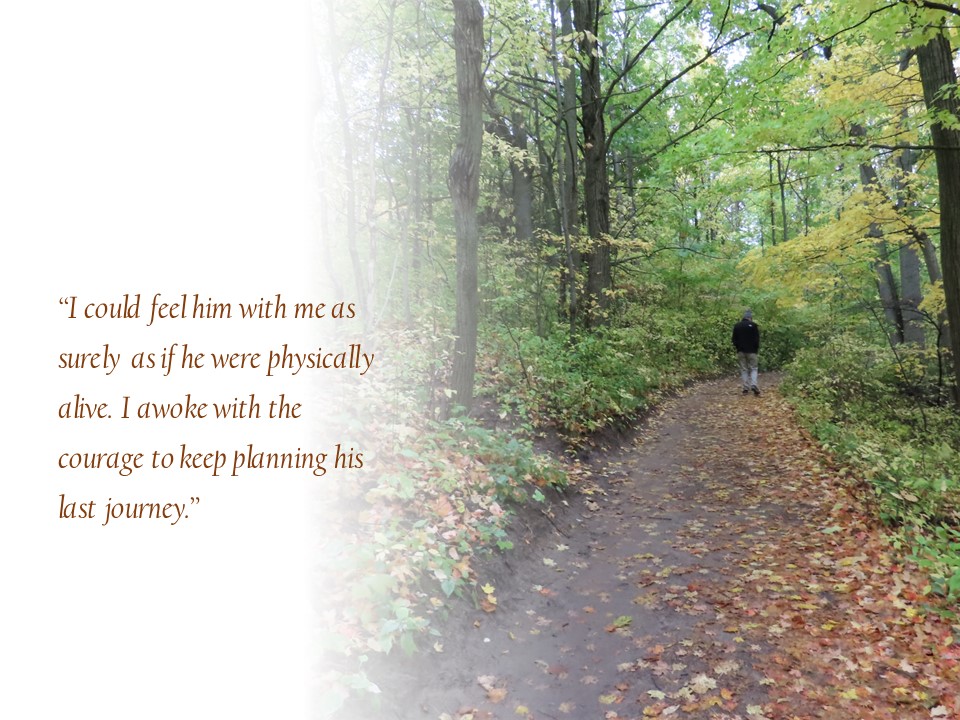
The day before I took the practice hike, I had another vision—again, just before I awoke. This time, I saw Scott. He was striding toward me, hale and healthy, dressed in his usual khaki pants, black fleece jacket and thick-soled boots as if ready for adventure. I was so delighted to see him this way. And I didn’t just “see” him; I could feel him with me as surely as if he were physically alive. I awoke with the courage to keep planning his last journey.
A day later I drove to the departure point, got my gear together, put the pack on my back and began our rehearsal walk. Soon, in my inner vision, I could see Scott off to the side, dressed just as he’d been the morning before. So, we walked together, me rehearsing exactly what I would do, what I might say as I let those ashes go. The steeply undulating trails were still slippery with ice and mud, so I made a note to be better prepared next time.
At the destination, I checked out each of three points from which I could scatter Scott’s last remains. Even though there had been only a gentle breeze when I’d left home in the town below, I could feel a stiff wind up there at the top. Carrying Scott’s ashes back out, they felt twice as heavy as they had on the way in, but I found that weight comforting, as if he were still with me. As I shed the knapsack and climbed back into the car, I thanked him for coming. We now had a plan.
A few days later, I took that last walk with Scott. Accustomed to the weight of the knapsack, and with the addition of cleats and a walking stick, my steps felt sure. He was not there in my inner vision this time; it was just me and his ashes and a close, foggy spring morning. At the peak, the air was calm. His ashes fell in a satisfyingly straight line into the rocky gorge below, and no other humans came near to interrupt the peace of my small ceremony there.
Now with the strength to continue on my own, I turned from the peak, shouldered the empty pack and made the trek back out.
I have felt him with me since, both in dreams and waking life and I know his visits come, no longer from obligation, but from love alone.
The Meaning of Forever Project continues to accept stories of comforting experiences with loved ones who have passed on, and of near-death experiences that have helped to show the continuation of life beyond the physical body. You can email your story to us atthemeaningofforever@gmail.com and you can find more about our project on our Facebook page, and our Meaning of Forever Website.
When John began taking ukulele lessons soon after the passing of his Hawaiian aunt, he had no idea how his simple attempt to reconnect with his roots would help his family heal. He tells his story below. All names but John’s are changed to protect the privacy of his family.
Ukulele Lesson Brings a Message of Love
By John Sambueno
At the beginning of December 2020, I received an email from my father letting me know my Auntie Kelly had lung cancer and did not have long to live. I had a real, loving connection with her. I had been close to her family growing up and actually lived with her for a year during college in California. Now three thousand miles away in Ontario, Canada, I was very sad not to be with her.
With a heavy heart I called one of my cousins who let me know that, at that moment, the whole family was with Auntie Kelly at the hospice. She took the phone and said to me, “You know Johnny, God always has a plan and I am at peace with His plan for me. I am happy that I have all my family here.”
I was amazed by how much grace she showed. Auntie was a devout Christian, but at the same time was open to God’s love being much bigger than religion. Many years ago, when she found out that I had begun following a religion called Eckankar, she asked me one question:, “Do you still believe in God?” I said, “Yes.” She replied, “OK.” Nothing else needed to be said.
A few weeks after the phone call, I received an email from my cousin Liz letting me know Auntie Kelly had passed away. I was sad about that, but happy I got a chance to say goodbye.
My Auntie was born and raised in Hawaii but spent her later life in California. I grew up in California, too, but had visited Hawaii a few times when I was much younger to spend time with my grandfather, Auntie Kelly and my cousins before they emigrated.
I was sad, but happy I got a chance to say goodbye.
I have always strongly identified with the Hawaiian part of my heritage. Several months after Auntie’s physical death, I decided to start taking ukulele lessons, feeling it would help me get in touch with my Hawaiian roots. One night I had a vivid dream: I was taking ukulele lessons, and my teacher turned out to be Auntie Kelly. I could feel unconditional love flowing from her, and I was filled with all this love even after the lesson was over. Still in the dream, I hung out with my cousins for a while like I used to when we were younger. It was a wonderful experience.
I have learned over the years that, when I have a vivid dream like this one, Divine Spirit is speaking to me at a deeper level. However, sometimes it takes a little work to decipher the true meaning. Something that helps me figure this out is a spiritual exercise I do every morning for 20-30 minutes. I sing the word HU (pronounced like “hue”) in long, drawn-out breaths. It is a simple, yet beautiful sound that helps me tune into Divine Spirit.
I usually include a visualization technique and, in this instance, Divine Spirit showed me a large bowl, which I realized represented me. There was tea (representing Divine Spirit) being poured into this bowl by my spiritual guide, or inner master. As the tea reached the top of the bowl, it would pour through tubes into small teacups.
Almost instantly, my dream with Auntie Kelly came to mind and I realized exactly what my dream meant. My Auntie had poured a whole bunch of unconditional love into me, but it wasn’t all meant for me. I was now meant to pour this love into other teacups and give it to my cousins. Once I realized this, I could hear my Auntie’s sweet Hawaiian voice say, “Johnny, will you give my love to my children. Please let them know I love them and will always be there for them if they just look within.” As I continued with the spiritual exercise the love filled up in me even more.
Almost instantly after my spiritual exercise ended, though, the mental part of me began to question what I had experienced. So, instead of writing an email to my cousins, I started up my treadmill and walked, wondering if I really should send this message of love. Would my cousins think of me as some weird but well-meaning spiritual person hoping to see something that wasn’t really there?
I could hear my Auntie’s sweet Hawaiian voice say, “Johnny, will you give my love to my children…”
But, as I walked, I continued to be filled with this amazing sense of love—and I heard my auntie’s voice again, “Please send my love to my children.” With a smile, I answered inwardly, “OK Auntie.”
Still, after composing the message to my cousins, I hesitated to send it. This time, I looked to a picture of Harold Klemp, the guide who serves as both my inner and outer master. “Should I actually send this email?” I asked. Instantly, he replied inwardly, “Will you be a fool for me?”
That was all I needed. I knew this was a play on some of Harold Klemp’s writings, in which he talks about being “a fool for God.” Of course I would be a fool for Divine Love. I sent the message and got back on the treadmill. There, I heard my Auntie’s voice one last time saying, “Thank you, Johnny.”
Each of my cousins replied to my message in a very loving way and expressed their gratitude that I shared it. They said how much pain they still felt at the loss of their mother. After reading the short note from my cousin Dan I cried for several minutes, because I could feel so deeply his pain and sorrow. I have a strong bond with Dan, who is outwardly tough and doesn’t show his emotions. I realized I was crying for him. (Although I still consider myself a tough guy, too, I am thankful Divine Spirit has softened me over the years.)
Looking back on the entire experience, I feel humbled and grateful that Divine Spirit and my Auntie gave me the opportunity to be a messenger of love to my cousins, who were still in such despair. What a gift it was to serve in that way, and to catch a glimpse into the wonder of eternity, where love and life continue.
I have come to understand the separation between “here” and “there” isn’t as great as I used to believe. In fact, it may all just be a matter of inner perception.
The Meaning of Forever Project continues to accept stories of comforting experiences with loved ones who have passed on, and of near-death experiences that have helped to show the continuation of life beyond the physical body. You can email your story to us at themeaningofforever@gmail.com and you can find more about our project on our Facebook page, and our Meaning of Forever Website.
Often, when a loved-one dies, we refer to having “lost” them. We feel the absence of their physical person as a kind of loss. But, what if that loss from our outer life can translate into a gain for our inner life? What if our loved-one’s departure opens a door into another stage in our relationship that actually boosts our spiritual and psychological well-being? In this story, Kim tells of just such a gain.
Mom – Home in Heaven and in My Heart
By Kim Ward
My mom died in a nursing home from a heart attack and complications of Alzheimer’s Disease on October 11, 2020, at 8:45 P.M. She had chosen that home six years earlier because she wanted to be with my severely disabled brother Scott, who already resided there.
When Covid-19 became a significant problem at nursing homes in Ontario, Canada, my sister Shannon and I would have “window visits” with Mom, where we would stand outside and wave to her while talking on cell phones with her nurse, who stood beside her. My mom had years before lost her ability to speak as well as her ability to recognize who we were. Nevertheless, my sister and I visited her as often as we could.
On Friday, October 9, the nursing home called early in the morning to tell us that Mom had gone into a coma and we should come as quickly as we could. Now, with Mom’s death imminent, my sister and I, or my husband Steve and I, could sit by her bedside as long as we were “gowned up’’ and wearing masks and gloves.
She lay back down, took three breaths and passed away. Steve and I just looked at each other and felt the room filled with love.
The night she died, Steve and I were there. She had not moved or been responsive in any way to anything we said or did. Then I noticed that my brother Scott, who had passed on three years before, was in the room with us. Previously, I had heard that those closest to the dying individual could come and accompany them to Heaven. I saw Scott as a little blue globe hovering near the ceiling in a corner of her room, and I knew it was him. He’d come to take Mom to Heaven.
Scott had been Mom’s favorite. He was her first born and had been medically challenged through most of his life. At birth, Scott had severely crossed eyes and had to have several surgeries to correct that problem. At age eight, he was diagnosed with severe Type One Diabetes and was so ill that he was not expected to live. Later as a young man, he developed Multiple Sclerosis. Mom had always dedicated herself to Scott and he was closest to her. So, it made sense that he would be the one to accompany her to heaven.
As soon as I saw Scott as the blue globe I said, “Mom, Scott is here. He’s waiting to take you to Heaven.” Immediately, Mom came out of her coma and sat up in bed, her eyes wide open with a huge smile on her face. Then, there was just calm. She lay back down, took three breaths and passed away. Steve and I just looked at each other and felt the room filled with love.
I was not overwhelmingly sad when Mom died because her Alzheimer’s meant that we had been saying goodbye to her for a long time. However, it took a few weeks after her death for me to forgive her for having so little time for me throughout my life. I had felt animosity towards Mom for not being there as a nurturing, protecting, loving mother. Now all that animosity is gone.
It happened this way: A friend told me that, often when people have a Near-Death experiences, they meet with a “Love Being” or a ”Being of Light” and are given a review of their lives. Well, perhaps my Mom had that experience at some point, because she seems more “enlightened” now when we meet. She comes to me often, and we communicate telepathically. She has apologized profusely for not giving me the parenting, love, and nurturing that every child needs. She knows she should have better protected me to prevent me from being repeatedly sexually abused by men.
Mom has changed since passing over, and I have changed too.
Mom has changed since passing over, and I have changed too. I have more appreciation of the various factors that kept Mom from having quality time with me. She had four children, two of whom had significant health needs; and, she had a husband who had paranoid schizophrenia, was a severe alcoholic and stayed in the basement all the time. Mom was responsible for the family finances as well as for care of our home and all of us children.
I now know that Mom had always loved me, but dealing with all she had to deal with, she simply had no time or energy for me. Now our relationship is one of all-encompassing acceptance, forgiveness and abiding love. Everything I have been through is worth the love I now feel. Death didn’t take Mom away from me. It gave her back to me.
You might ask how I am able to have this loving and healing contact with my Mom after her death. My answer would be that I know my Mom is alive in Heaven. Only her physical body has died. With an open, willing, and loving heart, I ask my Mom to come to be with me. Then she does.
The Meaning of Forever Project continues to accept stories of comforting experiences with loved ones who have passed on, and of near-death experiences that have helped to show the continuation of life beyond the physical body. You can email your story to us atthemeaningofforever@gmail.com and you can find more about our project on our Facebook page, and our Meaning of Forever Website.




 The Meaning of Forever