

By Ruth Edgett
It’s been a long time since you’ve seen a new post on The Meaning of Forever Blog, but I had to step back because my husband was dying and he needed me. Now that I’ve retaken level ground, the intention is to begin posting regularly once again. We’ll start with my story.
The apparent irony was not lost on me; that the person whose blogs touted an antidote to the pain of loss would be told a year-and-a-half into her project that she was heading for a heart-breaking loss of her own. But God wasn’t playing a cruel joke; It was handing me a gift. Stories of love from people around the world—with widely-varied lives and beliefs—let me focus on the positive, and to find reassurance in the experiences of others. When I needed it most, these stories confirmed what my project partner Joan and I weren’t alone in our assertion: Love truly does last forever.
Scott’s cancer diagnosis came in July of 2017, and only a few months later we learned it had already spread to his lymphatic system. There would be no cure, only treatments to hold off the inevitable. We knew three things that helped us accept this:
- The loving force that created us works always for our spiritual good, no matter how that looks to us;
- Before we entered these bodies at birth, we agreed to undergo experiences in this life that would take us toward that good, whether or not we remembered; and,
- That everything in the universes of Divine Spirit is in its rightful place.
From diagnosis onward, we knew this was not the end for Scott; rather, it was the beginning of a new spiritual passage. We had no idea where the road would lead us, but we trusted there was purpose in the journey. We focused our energy on living the best life we could, while we could.
As his final days neared in early 2022, Scott would wake sometimes from a doze seemingly in the midst of a conversation. This signalled he was moving between worlds, preparing for his final transition. We joked about it, how he got a kick out of switching from one state to the other, how he would surprise me at times with a sudden exclamation to some being in his other world. I asked if he knew where he was going, and he said he’d been shown, that he liked the place. As we talked about his leaving and me being left behind he assured me, in his gentlest voice, that the length of time until we’re together again—when it happens—will seem “like the blink of an eye.”
We’ll be together again
“In the blink of an eye.”
Scott’s final thirty-six hours were traumatic for both of us. It became impossible for him to take in enough oxygen using the prescribed at-home devices. After a harrowing night, he agreed to be taken by ambulance to the hospital emergency, where medical staff managed to stabilize him for a few hours—long enough for me to go home and get some sleep. But it didn’t last and I was called back, this time to accompany him to the Intensive Care Unit where we could say our final good-byes in private.
But we never got to do that. While I waited outside and the nurses settled him into his ICU bed, Scott left his physical body for the last time—just as they rushed me to him. I came upon him sitting upright, eyes staring, one hand raised as if hailing someone, heart already stopped. The nurses let me stay as long as I wanted, to hold his hand while his colour and warmth drained away, and to accustom myself to the fact his body was truly dead. I felt both cheated and guilty.
For all the attention we’d placed on bringing our best selves to the effort; for all our resolve to walk this last stretch of road together; for all the emergencies and near-misses; for all his determination to remain in his physical body as long as he possibly could—when Scott’s final moment came, I missed it.
Why didn’t I just stay with him all day? But we’d both been awake nearly thirty hours when I left him that last afternoon, and there was nowhere for me to rest. His room in the ER was barely big enough to hold a bed and the equipment to keep him breathing. There was one rigid, armless chair for me, which the doctors and nurses had to squeeze past to do their vital work.
“For all our resolve to walk this last stretch of road together…when Scott’s final moment came, I missed it.”
Part of our adjustment two years into Scott’s illness in 2019 was to sell the beautiful home we’d built on a magical property in the country. Scott was a gardener. He loved to plant things, to watch them grow and nurture them through their life cycles. He was with them before the first sign of shoots in spring until snow covered the ground in winter. He loved brightly coloured flowers and adopted reds and yellows as his theme. He envisioned our gardens as the house went up, and arranged them so there were special views from the rooms we used the most, ensuring there was always something in bloom. Later, still a gardener at heart when we’d moved to town, he arranged for delivery of fresh flowers every week with a card addressed to me.
It may have been the morning of, or a few days after I’d come home a widow exhausted and numb, that I saw this just before waking: A magnificent tree, tall and full, with giant trumpet-shaped blossoms in brilliant red and yellow, more vivid and fantastical than anything of this world. I knew it was Scott showing me a glimpse of his new home and saying all was as it should be, that I hadn’t let him down.
These events happened more than a year-and-a-half ago. When I look back on the months between, it’s hard to believe how much has happened since then, how much my life has changed and how many steps I’ve already taken to move forward. But earlier this year, as winter gave way to spring and the March 26 anniversary of Scott’s passing neared, the trauma of those last weeks came crashing back. As did some of our conversation in his final days.
When we got around to talking about funeral arrangements—which we left far too late, neither of us wanting to seem like we were rushing the end—I asked Scott what to do with his ashes. “I don’t care,” he said. “Just don’t keep them.”
“I asked Scott what to do with his ashes. ‘I don’t care,’ he said. ‘Just don’t keep them.'”
I knew what he meant. He didn’t want me so attached to him that I couldn’t get on with the rest of my life or allow him to be fully freed of his. I agreed but added, “I’m going to need you to hang around for the first year, though, just to make sure I’m okay.”
As the one-year mark loomed closer, I became increasingly anxious about what to do with those ashes—and whether I’d actually be able to let them go. I began to wonder what it would be like once Scott’s first-year promise expired. He prided himself on being a man of his word—and on being punctual. He expected the same of others, including me, though I often fell short on punctuality. All the same, I knew I needed to follow through on his wishes. After much consideration and contemplation, I decided the most fitting place to scatter the ashes would be from a high cliff overlooking our new neighbourhood. We had managed to hike there one day while Scott could still breathe well enough to make the trip. It had felt good to stand side-by-side looking out over our newly-adopted neighbourhood.
But as February gave way to March, I began to wonder if Scott would disappear forever once I spilled those ashes over the edge. In effect, by keeping my promise, I would be releasing him from his. But, how would I face the rest of my life without the visits and dreams and tiny signals that I’d had to comfort me all through my first year without him? At some point, a romantic verse from our teens began repeating in my memory: “If you love something, set it free. If it comes back, it’s yours. If it doesn’t, it never was.”
I started imagining how I would go about fulfilling my end of our bargain.
The section of cliff I write of is a busy place. People come from all over to hike the trails that eventually lead to a rock promontory rising 100 metres (300 feet) above the town, affording a grand view into the distance. There is rarely a day when a glance toward that look-out does not reveal any number of tiny figures gazing down on life below.
When could I get the peak to myself, and how exactly would I handle Scott’s ashes? It would have to be early morning on a weekday, the least likely time for tourists. Winds would have to be calm, something that rarely happens that high up.
I hadn’t asked the funeral home for an urn, knowing I wouldn’t be keeping the ashes, so they rested in a closet inside a sealed plastic bag within a sealed cardboard box, tucked inside a drawstring bag of deep green velvet. The most practical thing would be to put just the plastic bag inside a knapsack. But I would need something to cut the seal at my destination and another bag to enclose the first in case of spillage. I’d also need a small scoop to withdraw the ashes a bit at a time—both to test the wind and because I couldn’t bring myself to dump them all at once. And I’d need to accomplish all of this before the first wave of hikers arrived.
I needed to make a dry run.
“Now with the strength to continue on my own, I turned from the peak, shouldered the empty pack and made the trek back out.”
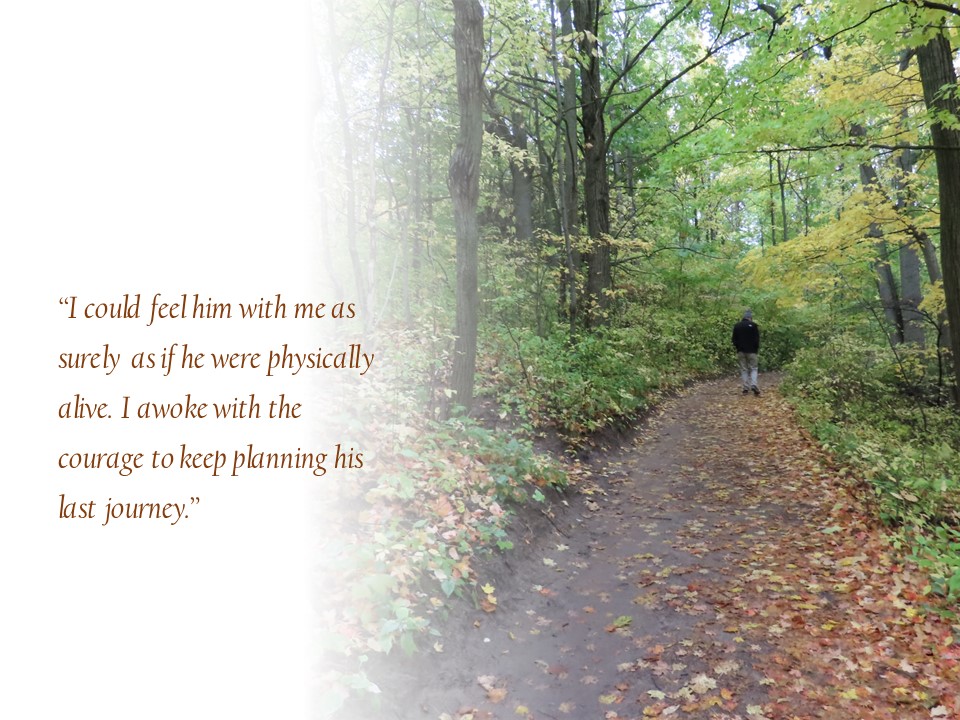
The day before I took the practice hike, I had another vision—again, just before I awoke. This time, I saw Scott. He was striding toward me, hale and healthy, dressed in his usual khaki pants, black fleece jacket and thick-soled boots as if ready for adventure. I was so delighted to see him this way. And I didn’t just “see” him; I could feel him with me as surely as if he were physically alive. I awoke with the courage to keep planning his last journey.
A day later I drove to the departure point, got my gear together, put the pack on my back and began our rehearsal walk. Soon, in my inner vision, I could see Scott off to the side, dressed just as he’d been the morning before. So, we walked together, me rehearsing exactly what I would do, what I might say as I let those ashes go. The steeply undulating trails were still slippery with ice and mud, so I made a note to be better prepared next time.
At the destination, I checked out each of three points from which I could scatter Scott’s last remains. Even though there had been only a gentle breeze when I’d left home in the town below, I could feel a stiff wind up there at the top. Carrying Scott’s ashes back out, they felt twice as heavy as they had on the way in, but I found that weight comforting, as if he were still with me. As I shed the knapsack and climbed back into the car, I thanked him for coming. We now had a plan.
A few days later, I took that last walk with Scott. Accustomed to the weight of the knapsack, and with the addition of cleats and a walking stick, my steps felt sure. He was not there in my inner vision this time; it was just me and his ashes and a close, foggy spring morning. At the peak, the air was calm. His ashes fell in a satisfyingly straight line into the rocky gorge below, and no other humans came near to interrupt the peace of my small ceremony there.
Now with the strength to continue on my own, I turned from the peak, shouldered the empty pack and made the trek back out.
I have felt him with me since, both in dreams and waking life and I know his visits come, no longer from obligation, but from love alone.
The Meaning of Forever Project continues to accept stories of comforting experiences with loved ones who have passed on, and of near-death experiences that have helped to show the continuation of life beyond the physical body. You can email your story to us atthemeaningofforever@gmail.com and you can find more about our project on our Facebook page, and our Meaning of Forever Website.
 The Meaning of Forever