If you ask Renee Moor what inspired her to found Journey Home, a non-profit community service dedicated to “empowered living and dying,” she can list many ways her own life has prepared her. It began with proving herself after being told, as a late-developing child, that the best she could hope for was assisted living; it continued through two decades as a behavioural therapist helping parents cope with autism diagnoses for their children; it carried on through her practices as a Buddhism psychotherapist, a student and instructor of yoga, and as a master in the art of reiki healing. But even these, compounded by the deaths of her father and husband within 18 months of each other, don’t complete the story.
The experiences that locked into place the final piece of Renee’s life puzzle came in her dreams.
“My dad just kept coming and coming in my dreams and guiding me,” says Renee of the years after her father’s death. Seated in the space she has created for people to meet, share, and learn from each other as they go through their individual experiences with death and dying, Renee is relaxed and confident. “In all my twists and turns of life,” she says, “I found my way.”
Already a reiki master and busy yoga instructor at the onset of the Covid pandemic, Renee found herself in the same situation as many: cut off from her livelihood and society in general. It was in those dark days alone at home, with the time to fully process the loss of those she loved, that she began to thoroughly embrace the practices of meditation embedded in both yoga and Buddhism. Then came a series of visions and vivid dreams that inspired her to train as a death doula.
Much like a childbirth doula, a death doula supports a dying person and their family through the dying process, first by helping them gain information and insight, by connecting them with available medical and community supports, and finally by helping make the last moments a positive experience.
“I saw a huge gap in services, because doctors and nurses focus on treatment; funeral homes and crematoriums focus on the remains—but, there’s no one there for the death.”
In contrast, says Renee, her father showed his family that death can be beautiful. “He made his dying about us and we made his dying about him.
“He knew he had six months to live after his diagnosis of pancreatic cancer, and after his fear, anger and sadness, he chose acceptance and love. Each day he showed up to life as fully as he could, both on his good days and his bad days.
“We as a family have beautiful, funny and grateful memories of the season my dad died. After his dying, I wanted everyone to experience a death like this, but life had other plans for me then.”
As time went on, though, says Renee, “He kept coming to me in dreams and meditations. He would offer the most profound philosophies, and now I see he was preparing me. As I opened my heart and mind, his message became clearer to me.”
Renee looks back on three dreams as pivotal to placing her where she is now. One came not long after her father’s death, where she saw him striding down a rocky slope with arms wide open. “Don’t worry about me,” he called to her. “I’m in a better place.”
Some time later, as Renee’s life went through more changes and she began to focus her energy on services for those touched by death and dying, her father appeared in another dream. He asked her to meet him on Dundas Street, which is a stretch of highway that connects the city of Hamilton in Ontario, Canada, with the city of Toronto, about 65-kilometres away. For Renee at the time, this location was symbolic of her life adventures up until then.
“… [N]ow I see he was preparing me. As I opened my heart and mind, his message became clearer …”
As she walked down the street to meet him, a large building seemingly made of white lights guided her toward him. Again, her father held his arms open to her and she ran to him. As they met, Renee’s car keys caught in the back of the sweater he was wearing. As her older sister helped disentangle them, Renee’s father said, “Don’t worry. We all get a little lost sometimes, but now you’ve found your way.”
Soon after that dream, Renee became aware of a location for rent in a small town next door to Hamilton. Surveying the bright, high-ceilinged space inside a large heritage building in the centre of the community, Renee knew this was the perfect location for Journey Home. As she stepped back outside and looked toward the main street, she understood the true force of that dream: Journey Home would be located in a town called Dundas.
Not only that. As a student and instructor of yoga, Renee knew that the entanglement at the back of her father’s neck had significance. It sits opposite the throat chakra which represents how we express ourselves, how we listen and how we communicate. For Renee, Journey Home is more than a suite of services for an underserved segment of the population; Journey Home is her means of expression.
All the same, championing an organization whose services centre around death and dying is a daunting prospect. While people who work in hospice care and a handful of medical professionals understand the value she brings to her community, the majority of health practitioners have not been so receptive. Despite having established a board of directors, together with a group of supporters and co-workers to help ensure Journey Home’s success, there are days when she feels very alone.
But, says Renee, her father has an answer for that, too. In another dream, she came upon him carrying large sacks of flour up a stairway. “I’ll do the heavy lifting,” he told her. “You just keep baking the bread.”
Editor’s Note: Until recently, the retail space next door to Journey Home was occupied by a thriving business called The Village Bakery.
The Meaning of Forever Project continues to accept stories of comforting experiences with loved ones who have passed on, and of near-death experiences that have helped to show the continuation of life beyond the physical body. You can email your story to us atthemeaningofforever@gmail.com and you can find more about our project on our Facebook page, and our Meaning of Forever Website.
It’s been a long time since you’ve seen a new post on The Meaning of Forever Blog, but I had to step back because my husband was dying and he needed me. Now that I’ve retaken level ground, the intention is to begin posting regularly once again. We’ll start with my story.
The apparent irony was not lost on me; that the person whose blogs touted an antidote to the pain of loss would be told a year-and-a-half into her project that she was heading for a heart-breaking loss of her own. But God wasn’t playing a cruel joke; It was handing me a gift. Stories of love from people around the world—with widely-varied lives and beliefs—let me focus on the positive, and to find reassurance in the experiences of others. When I needed it most, these stories confirmed what my project partner Joan and I weren’t alone in our assertion: Love truly does last forever.
Scott’s cancer diagnosis came in July of 2017, and only a few months later we learned it had already spread to his lymphatic system. There would be no cure, only treatments to hold off the inevitable. We knew three things that helped us accept this:
The loving force that created us works always for our spiritual good, no matter how that looks to us;
Before we entered these bodies at birth, we agreed to undergo experiences in this life that would take us toward that good, whether or not we remembered; and,
That everything in the universes of Divine Spirit is in its rightful place.
From diagnosis onward, we knew this was not the end for Scott; rather, it was the beginning of a new spiritual passage. We had no idea where the road would lead us, but we trusted there was purpose in the journey. We focused our energy on living the best life we could, while we could.
As his final days neared in early 2022, Scott would wake sometimes from a doze seemingly in the midst of a conversation. This signalled he was moving between worlds, preparing for his final transition. We joked about it, how he got a kick out of switching from one state to the other, how he would surprise me at times with a sudden exclamation to some being in his other world. I asked if he knew where he was going, and he said he’d been shown, that he liked the place. As we talked about his leaving and me being left behind he assured me, in his gentlest voice, that the length of time until we’re together again—when it happens—will seem “like the blink of an eye.”
We’ll be together again “In the blink of an eye.”
Scott’s final thirty-six hours were traumatic for both of us. It became impossible for him to take in enough oxygen using the prescribed at-home devices. After a harrowing night, he agreed to be taken by ambulance to the hospital emergency, where medical staff managed to stabilize him for a few hours—long enough for me to go home and get some sleep. But it didn’t last and I was called back, this time to accompany him to the Intensive Care Unit where we could say our final good-byes in private.
But we never got to do that. While I waited outside and the nurses settled him into his ICU bed, Scott left his physical body for the last time—just as they rushed me to him. I came upon him sitting upright, eyes staring, one hand raised as if hailing someone, heart already stopped. The nurses let me stay as long as I wanted, to hold his hand while his colour and warmth drained away, and to accustom myself to the fact his body was truly dead. I felt both cheated and guilty.
For all the attention we’d placed on bringing our best selves to the effort; for all our resolve to walk this last stretch of road together; for all the emergencies and near-misses; for all his determination to remain in his physical body as long as he possibly could—when Scott’s final moment came, I missed it.
Why didn’t I just stay with him all day? But we’d both been awake nearly thirty hours when I left him that last afternoon, and there was nowhere for me to rest. His room in the ER was barely big enough to hold a bed and the equipment to keep him breathing. There was one rigid, armless chair for me, which the doctors and nurses had to squeeze past to do their vital work.
“For all our resolve to walk this last stretch of road together…when Scott’s final moment came, I missed it.”
Part of our adjustment two years into Scott’s illness in 2019 was to sell the beautiful home we’d built on a magical property in the country. Scott was a gardener. He loved to plant things, to watch them grow and nurture them through their life cycles. He was with them before the first sign of shoots in spring until snow covered the ground in winter. He loved brightly coloured flowers and adopted reds and yellows as his theme. He envisioned our gardens as the house went up, and arranged them so there were special views from the rooms we used the most, ensuring there was always something in bloom. Later, still a gardener at heart when we’d moved to town, he arranged for delivery of fresh flowers every week with a card addressed to me.
It may have been the morning of, or a few days after I’d come home a widow exhausted and numb, that I saw this just before waking: A magnificent tree, tall and full, with giant trumpet-shaped blossoms in brilliant red and yellow, more vivid and fantastical than anything of this world. I knew it was Scott showing me a glimpse of his new home and saying all was as it should be, that I hadn’t let him down.
These events happened more than a year-and-a-half ago. When I look back on the months between, it’s hard to believe how much has happened since then, how much my life has changed and how many steps I’ve already taken to move forward. But earlier this year, as winter gave way to spring and the March 26 anniversary of Scott’s passing neared, the trauma of those last weeks came crashing back. As did some of our conversation in his final days.
When we got around to talking about funeral arrangements—which we left far too late, neither of us wanting to seem like we were rushing the end—I asked Scott what to do with his ashes. “I don’t care,” he said. “Just don’t keep them.”
“I asked Scott what to do with his ashes. ‘I don’t care,’ he said. ‘Just don’t keep them.'”
I knew what he meant. He didn’t want me so attached to him that I couldn’t get on with the rest of my life or allow him to be fully freed of his. I agreed but added, “I’m going to need you to hang around for the first year, though, just to make sure I’m okay.”
As the one-year mark loomed closer, I became increasingly anxious about what to do with those ashes—and whether I’d actually be able to let them go. I began to wonder what it would be like once Scott’s first-year promise expired. He prided himself on being a man of his word—and on being punctual. He expected the same of others, including me, though I often fell short on punctuality. All the same, I knew I needed to follow through on his wishes. After much consideration and contemplation, I decided the most fitting place to scatter the ashes would be from a high cliff overlooking our new neighbourhood. We had managed to hike there one day while Scott could still breathe well enough to make the trip. It had felt good to stand side-by-side looking out over our newly-adopted neighbourhood.
But as February gave way to March, I began to wonder if Scott would disappear forever once I spilled those ashes over the edge. In effect, by keeping my promise, I would be releasing him from his. But, how would I face the rest of my life without the visits and dreams and tiny signals that I’d had to comfort me all through my first year without him? At some point, a romantic verse from our teens began repeating in my memory: “If you love something, set it free. If it comes back, it’s yours. If it doesn’t, it never was.”
I started imagining how I would go about fulfilling my end of our bargain.
The section of cliff I write of is a busy place. People come from all over to hike the trails that eventually lead to a rock promontory rising 100 metres (300 feet) above the town, affording a grand view into the distance. There is rarely a day when a glance toward that look-out does not reveal any number of tiny figures gazing down on life below.
When could I get the peak to myself, and how exactly would I handle Scott’s ashes? It would have to be early morning on a weekday, the least likely time for tourists. Winds would have to be calm, something that rarely happens that high up.
I hadn’t asked the funeral home for an urn, knowing I wouldn’t be keeping the ashes, so they rested in a closet inside a sealed plastic bag within a sealed cardboard box, tucked inside a drawstring bag of deep green velvet. The most practical thing would be to put just the plastic bag inside a knapsack. But I would need something to cut the seal at my destination and another bag to enclose the first in case of spillage. I’d also need a small scoop to withdraw the ashes a bit at a time—both to test the wind and because I couldn’t bring myself to dump them all at once. And I’d need to accomplish all of this before the first wave of hikers arrived.
I needed to make a dry run.
“Now with the strength to continue on my own, I turned from the peak, shouldered the empty pack and made the trek back out.”
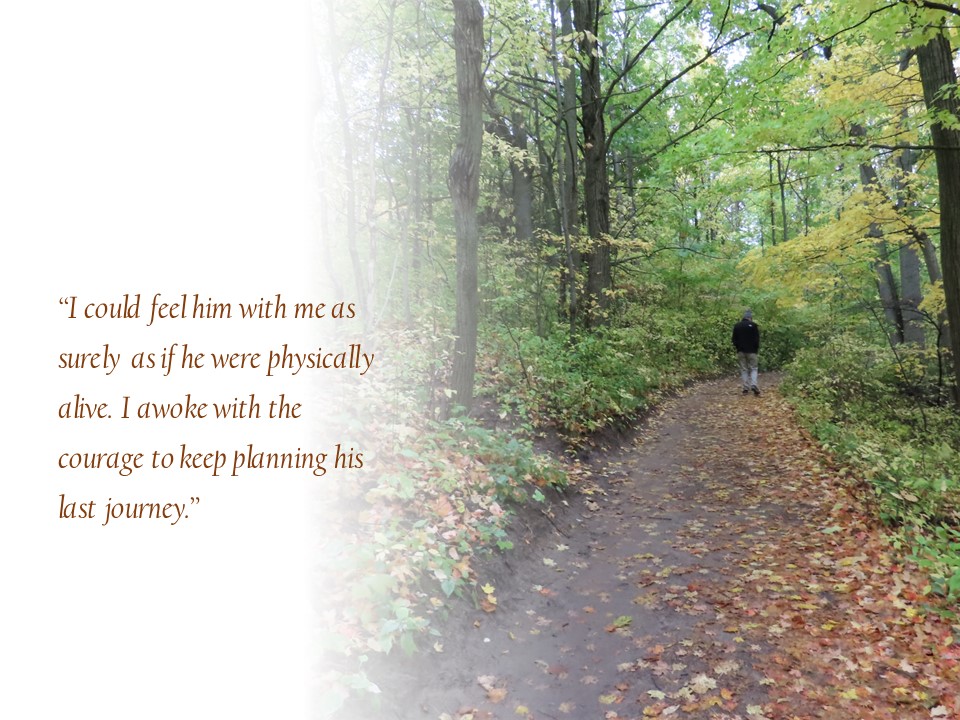
The day before I took the practice hike, I had another vision—again, just before I awoke. This time, I saw Scott. He was striding toward me, hale and healthy, dressed in his usual khaki pants, black fleece jacket and thick-soled boots as if ready for adventure. I was so delighted to see him this way. And I didn’t just “see” him; I could feel him with me as surely as if he were physically alive. I awoke with the courage to keep planning his last journey.
A day later I drove to the departure point, got my gear together, put the pack on my back and began our rehearsal walk. Soon, in my inner vision, I could see Scott off to the side, dressed just as he’d been the morning before. So, we walked together, me rehearsing exactly what I would do, what I might say as I let those ashes go. The steeply undulating trails were still slippery with ice and mud, so I made a note to be better prepared next time.
At the destination, I checked out each of three points from which I could scatter Scott’s last remains. Even though there had been only a gentle breeze when I’d left home in the town below, I could feel a stiff wind up there at the top. Carrying Scott’s ashes back out, they felt twice as heavy as they had on the way in, but I found that weight comforting, as if he were still with me. As I shed the knapsack and climbed back into the car, I thanked him for coming. We now had a plan.
A few days later, I took that last walk with Scott. Accustomed to the weight of the knapsack, and with the addition of cleats and a walking stick, my steps felt sure. He was not there in my inner vision this time; it was just me and his ashes and a close, foggy spring morning. At the peak, the air was calm. His ashes fell in a satisfyingly straight line into the rocky gorge below, and no other humans came near to interrupt the peace of my small ceremony there.
Now with the strength to continue on my own, I turned from the peak, shouldered the empty pack and made the trek back out.
I have felt him with me since, both in dreams and waking life and I know his visits come, no longer from obligation, but from love alone.
The Meaning of Forever Project continues to accept stories of comforting experiences with loved ones who have passed on, and of near-death experiences that have helped to show the continuation of life beyond the physical body. You can email your story to us atthemeaningofforever@gmail.com and you can find more about our project on our Facebook page, and our Meaning of Forever Website.
For many of us, the death of a parent is particularly difficult, because we have unresolved issues that have accumulated over the years, and that remain unresolved at the time of our parent’s passing. Below, Maggie tells us about her long estrangement from her mother and brother due to their mother’s schizophrenia. In later years, she and her mother were able to heal their rift, and her brother was able to be present in the hours before their mother passed away. This reunion–even as her mother lay dying–led Maggie to declare to the cleric who was present at the time that she felt like she’d “won the lottery.” And, as Maggie shows us here, the healing continues–even after her mother’s physical presence is gone.
By Maggie Martin
In my family, we were all estranged from each other. I left home in Ontario, Canada, at the age of 19, unable to cope on my own with the increasing challenges of my mother’s schizophrenia. My brother Larry had left several years earlier, and my parents had already separated during my early teens because Dad couldn’t cope either.
Mom’s illness prevented her from forming close, loving and lasting relationships, and it was only in the last ten years of her life that I learned to accept her for who she was. During that time, we spent many hours together and I came to adore her. In the intervening years, however, I had only minimal contact with Mom. Larry didn’t see her during this period, so I didn’t see him either. He had relocated across the country to Calgary, Alberta.
Despite all of this, I knew I was very much loved by my mom in the best way she knew how. I believe she adored both my brother and me. Larry’s estrangement was very painful for Mom and me.
When she was in her early sixties, Mom’s schizophrenia spiralled out of control, and she was placed in a retirement home where the medical professionals could monitor and regulate her medications. It was an eight-hour return drive from where Mom lived to where I lived with my husband in Southern Ontario. I still wanted us to be in touch, so I would invite her to come and stay with us. Mom and I became very close. I truly wished my brother could know this person and not the one he had grown up with.
Amazingly, my relationship with Mom only got better and better as I became older. Every Sunday at 4:30 p.m. I would telephone her at the retirement home. This went on for fifteen years or so. One Sunday, Mom didn’t answer the phone. The nurse went to investigate and found her on the floor of her room and immediately called an ambulance. Then the nurse called me back to let me know that Mom would be admitted to hospital. Early next morning was the soonest I could drive north. She had an MRI (magnetic resonance imaging) scheduled first thing in the morning, so I arrived on Monday in time to go with her and hold her hand. The plan was that, after she returned to her hospital room, I would go have lunch, then return to her bedside.
“Amazingly, my relationship with Mom only got better and better as I became older.”
I had helped her settle back into bed following her MRI and was just about to leave when my cell phone rang. Even though I have a policy of not answering my phone in the midst of another conversation, I did pick it up. It was Mom’s doctor telling me I needed to immediately let her know that she was extremely ill and dying, and that I needed to phone my brother and tell him the same thing. I was shocked and confused. I knew my face would give that away, so I stumbled out of the room without saying anything to Mom.
A nurse saw me and came immediately to my side and asked, “Are you okay?” I said, “No”.
I was still holding my phone and staring at it. The nurse asked me what had happened. I told her what the doctor had said. I think the nurse took the phone from me, perhaps to talk with him. Finally she said, “Follow me. I’ll take you to a room behind the nurses’ station where you can make your phone calls.”
After I entered the room, I stood there staring at the phone on the wall. Then I looked around and was surprised to see a man sitting there. He asked if he could be of help. I told him I needed to make some phone calls. He came to sit next to me and I moved away. He asked if he was bothering me. I said, “Yes,” so he left the room, but not before he conveyed to me—either verbally or telepathically—that I didn’t have to worry about making those calls. Just as he was leaving, the nurse entered. She asked me who he was. When I said, “I don’t know,” she immediately went looking for him.
Soon, the nurse sought me out and told me she hadn’t been able to find the mysterious man, but that I didn’t need to make the calls because the doctor had phoned my brother and had also broken the news to Mom. So, the man in the nurse’s room had been correct. I didn’t have to worry about making those calls.
Only later did I realize who he was: my inner and outer spiritual guide, Harold Klemp. He is the leader of my spiritual path called Eckankar, and I had seen him previously in a public venue, but never before up close. I had always thought of him as larger in stature than he appeared in person. What I did get from our “chance” meeting was that he was there to help when needed, and that all was in its rightful place, both for me and for Mom.
“What I did get from our ‘chance’ meeting was that he was there to help when needed and that all was in its rightful place, both for me and for Mom.”
However, it now became imperative for my brother to come immediately if he wanted to see Mom prior to her death. He was able to catch the first flight out and arrived from Calgary in the wee hours of Wednesday morning, so exhausted that he lay down on a bed next to Mom’s and slept. Soon afterwards, a nondenominational chaplain came in. Mom was awake now. On one side was her much loved son Larry, and on the other side was her much loved daughter, me.
With a big smile on my face, I exclaimed to the chaplain, “I feel like I just won a million dollars! I feel like I just won the lottery!”. Mom had a broad grin on her face too! She had what she wanted most: Her two children sitting on either side of her. The estrangement was over. Mom died peacefully a few minutes later.
Since Mom’s death, my brother and I have kept in contact. We have both realized that there never was any disagreement between us; we had simply felt overwhelmed trying to cope with the difficulties of Mom’s disease. Since then, not only have Larry and I kept in touch, but Mom and I keep in touch too.
I recently asked myself anew how Mom communicates with me now. Just as I asked this question, a beautiful female cardinal appeared right in front of me. I could reach out and touch her, she was that close. Cardinals were one of our family’s favourite birds, but it had been a long time since I had spotted one—and I had never seen one where I now live.
The sighting reminded me of an experience I’d had years ago. It was not long after my father passed away. Even though Mom and Dad chose to separate when they were in their early forties, they had never legally formalized it. Technically, they were still married when Dad died at the age of eighty-nine. He was buried in a small community cemetery close to my home in Southern Ontario.
During one of Mom’s vacations to my home, she had asked to visit Dad’s grave and say goodbye. So, I drove her there one beautiful, sunny afternoon. Standing at the graveside, Mom said, “I guess I’m a widow now.” That really surprised me, and I could see that, even after all those years of separation, her marriage had been very important to her.
We buried Mom beside Dad. I was by myself when the internment was over at the small community cemetery. There wasn’t a cloud in the sky as I watched a pair of Canada geese fly directly overhead. As a child I had been taught that Canada geese pair for life. To me this signified that Mom was safe, happy and reunited with Dad. She was, once again, with the love of her life.
“There wasn’t a cloud in the sky as I watched a pair of Canada geese fly directly overhead… To me this signified that Mom was safe, happy and reunited with Dad. She was, once again, with the love of her life.”
With the recent appearance of the female cardinal, Mom was answering my question, showing me one way that she does still communicate with me.
Just a day before I finished writing this story, I had a wonderful opportunity to be part of a monthly discussion on the book titled Stranger by the River. It is a poetic book on the secret knowledge of God, written by Paul Twitchell, the modern-day founder of Eckankar. The chapter we were studying that night was titled “Love.” A particular line caught my attention. It said: “But I say that all disagreement between friends and thee comes from impatience. If you have patience, then life will teach thee better.”
As I studied that chapter, I began to understand more about my relationship with Mom, and how and why it changed over the years. What changed was that I learned patience. I stopped arguing with her. Mom was doing the best that she could in her illness, and I was learning to accept her for who she was. During those years that we became closer, I realized I had been given the gift of a mom who was a wonderful, joyful soul. Very simply, I learned to love her as she was—and is—in my ongoing Meaning of Forever relationship with her.
The Meaning of Forever Project continues to accept stories of comforting experiences with loved ones who have passed on, and of near-death experiences that have helped to show the continuation of life beyond the physical body. You can email your story to us atthemeaningofforever@gmail.com and you can find more about our project on our Facebook page, and our Meaning of Forever Website.
Perhaps you’ve accepted the idea that, after our loved ones (people at least) exit this life, they spend time learning and trying new things—preparing, maybe, for their next mission. Well… what if this is true for animals, too? In this story, first published on Animals are Soul, Lois relates how dreams showed her the progress of a dear departed dog who was being made ready to come back as a rambunctious golden puppy. It is reprinted here with permission.
DREAMS OF A GOLDEN PUPPY BEING REBORN
By Lois Stanfield, Minnesota, USA
When my newly adopted, rescued Afghan Hound, Lila, came to live with my other Afghan, Pistachio, and me, I had to help her accept her newfound freedom. Eventually she graduated from being a dog who had lived in a kennel to a beloved house pet. After a while she blossomed into quite a character. She started talking all the time in the way dogs talk. She always had something to say and was quite definite about what she wanted. Ultimately, she ruled the roost.
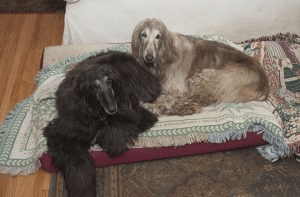
Although each dog had a bed, one was more comfortable than the other. Being senior resident in the household, Pistachio had the softer bed. But Lila wanted that bed and would sometimes sit on top of him until he got up and left. Then she’d claim the preferred bed. She was hilarious, and the two of them made a cute little couple.
Pistachio was kind and patient with Lila, and they grew to love each other. We had a wonderful three and a half years together. Because she had never known human love before coming to my home, Lila was more comfortable bonding with me through Pistachio. He was like her little husband, and she loved me because he loved me.
Pistachio passed away when Lila was about thirteen, and she was extremely depressed at the loss of her best friend. It took some time, but gradually she bonded more and more with me. Before long it got to where we spent every evening snuggled up together on the sofa. Lila captured my heart like no other. Our time together was precious, and I loved her dearly.
Lila’s Journey
At the age of fourteen and a half, Lila developed serious health issues. The veterinarian did all she could to help her recover, but true to her nature, Lila was quite clear in letting me know what she wanted. It was her time to go. With love and gratitude for the time she had spent with me, I let her move on with her own spiritual journey.
My previous animal companions had always communicated after their death where they were, what they were doing, and what their next lifetime would be. I would get insights either in the dream state or during a spiritual exercise. But after Lila passed, I didn’t get any visits or information from her. Nothing. It was like a complete void.
After a few weeks with no inner messages, I asked for help from the Mahanta, my inner spiritual guide. Even though Lila had experienced over three years of love in my home, she’d previously endured ten years of abuse. In a spiritual exercise, I was told that Lila was being rehabilitated on the inner planes, and I could not see her.
So I let go, trusted, and moved on with my life.
Khiley
I adopted a beautiful, seven-year-old, male Afghan Hound named Khiley, who had been rescued from the same kennel situation as Lila three and a half years earlier. He lived with a dear friend of mine, Louise, who had four other Afghans.
Khiley had some emotional damage and did not get along with Louise’s other dogs. Life was miserable for all of them, as he could not adjust to the pack. He wanted a person who would be all his own—someone he could bond with and devote himself to. I was the perfect “mom” for him. He entered my life, filling the gaping hole that Lila’s departure had left.
A Dream with Lila
A few months after adopting Khiley, I began to once again wonder about Lila and had a dream with her. She’d graduated from the inner-world rehab center and was in a halfway house where she could safely and gradually reorient herself into entering a new physical life. A wonderful man served as caretaker there. Lila had all the treats and toys she wanted, and she played with other dogs. Appearing to be about two years old, she was cute, fluffy, happy, and spunky. She looked fantastic.
At the halfway house in my dream I wanted to embrace Lila, but she ran away. The caretaker winked at me and said, “I think she likes it here. She’s not ready to come back yet.” As the dream ended, I knew Lila was progressing and everything was good. I had to let go and not be concerned about her.
Many more months passed, and I bonded more and more deeply with my beloved Khiley. Then I had yet another dream with Lila. This time, she ran to play with me. I knew she was letting me know that she was getting ready to return. But when, where, and how remained a mystery.
A month later, I dreamed of a little golden puppy being born and received inner confirmation that Lila was coming back very soon. Not long after the dream, I learned that Louise was going to breed her female Afghan. In a few months, there would be a new litter of Afghan Hound puppies. I felt certain Lila would be returning in that litter.
I started thinking, OK. Lila’s coming back. What am I going to do? If I adopt her in her new puppy body, it won’t be good for Khiley. I didn’t know what to do and had to surrender the situation to Divine Spirit.
The puppies were born, and one of them, true to my dream, had gold coloring. Normally, Afghan Hounds have big litters of eight to ten puppies, but Louise’s new litter consisted of only two. She and her sister each wanted one. This meant I didn’t have to make a choice about adopting a reincarnated Lila. Louise chose the gold puppy for herself, and her sister took the other one.
Sprite
After getting to know Louise’s puppy, I realized she was, indeed, Lila. As Soul, Lila had chosen to reincarnate not with me but near me. This put her into the fabulous home of one of my dearest friends. And I would get to see her all the time.
Louise named the “Lila” puppy Sprite. She was huge at birth and soon grew fat, attaching herself to her mother and nursing on her continuously. The other puppy in the litter was small and normal. As Sprite, the Soul in this tiny new puppy body seemed to be making up for the hunger previously endured as Lila. Sprite was the fattest puppy I’d ever seen.
This golden puppy grew into the most gorgeous creature—the color of pale butter, with a black mask. Louise watches in amazement at how Sprite reacts to me. Sprite loves people but isn’t quite as enthusiastic with other visitors as she is with me. When I visit, she almost literally comes flying to me. If I sit down, she leaps into my lap. I get mauled with doggy kisses.
Louise calls me Auntie, because I’m like this puppy’s aunt. Sprite’s affection has been affirmation that she truly is Lila returned. I love her dearly in this lifetime too and am grateful to see her often. As a wonderful side benefit, Khiley got to keep his mommy completely to himself. He has become the sweetest, most loving dog I’ve ever had.
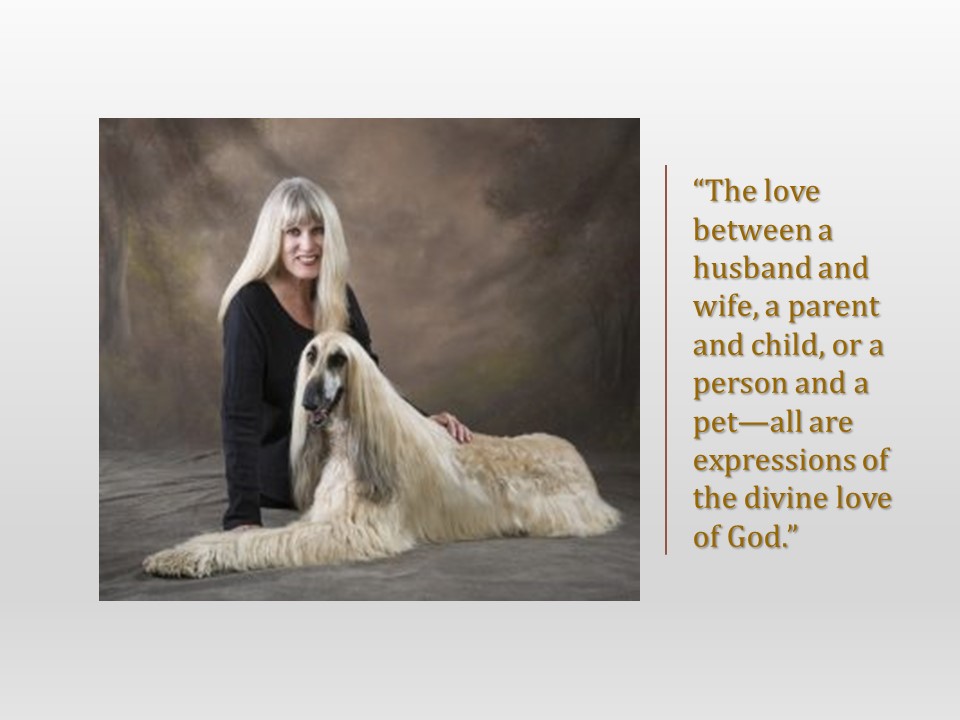
I’ve learned much from my beloved dogs in the many years they have come and gone. Most of all, they have taught me how the love between Souls, whether in an animal or a human body, is unbreakable and timeless. For me, there is no superior form of love. The love between a husband and wife, a parent and child, or a person and a pet—all are expressions of the divine love of God.
“Dreams of a Golden Puppy Being Reborn” by Lois Stanfield is published with permission of Eckankar. All Rights Reserved. Copyright Eckankar, 2019, www.Eckankar.org. The story was first published in “Animals Are Soul” blog, www.AnimalsAreSoul.blog.
The Meaning of Forever Project continues to accept stories of comforting experiences with loved ones–animal or human–who have passed on, and of near-death experiences that have helped to show the continuation of life beyond the physical body. You can email your story to us atthemeaningofforever@gmail.com and you can find more about our project on our Facebook page, or our Meaning of Forever Website.








 The Meaning of Forever