


Imagine you’re sitting with someone you love during their last days of earthly life. They’re saying things that make no sense. Maybe you’ve discounted this as delirium or the automatic mutterings of a mind and body winding down to the final moment.
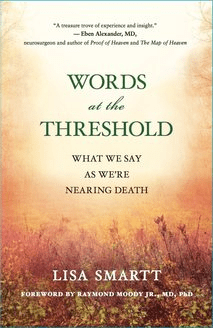
But, what if the nonsense you’re hearing isn’t nonsense at all? What if it’s actually a conscious attempt at using limited earthly language to describe a world there are no earthly words for? This is a theory developed by linguist Lisa Smartt in her 2017 book called Words at the Threshold: What we say as we’re nearing death (New World Library, Novato, California).
In Smartt’s vocabulary, words that don’t make sense to the hearer are not necessarily “nonsense” in the way most of us consider that word. Yes, they’re non-sense, in that we don’t understand what they mean, she says. But that’s only because the listener hasn’t cracked the code. And, according to her research into the words of people who are dying, there is a code—or, at least, a system of sense-making that can be applied.
Smartt says her research (in which she asked loved ones and care givers to record the words of dying patients) revealed that they often spoke in metaphor, or in language that seemed to symbolize something the patient was experiencing but didn’t have precise words to describe. And, she says, these metaphors seemed to evolve as the process of dying wound down.
“While some of the words may seem nonsensical when heard in isolation, they often form cohesive patterns over the course of days and weeks,” she writes.
Smartt gives the example of a woman who tracked the expressions of her great-uncle. On four separate occasions, he spoke of a group of poker players asking him to join their game. “They’re telling me I have to play and I just don’t want to,” he said in the beginning. Five days later, he said, “I don’t have no choice now, do I? They’re bad folks though…” The last time, ten days after that, her uncle said, “It’s okay. I don’t have much choice anyway… I’ll get out of my old chair here and sit with them.”
Often, palliative patients speak of a journey, says Smartt, or the need to get ready for one; they speak of visits from deceased loved ones, or of other beings who have come to escort them to a destination. They talk about modes of transport, of needing to go somewhere, of doors to be passed through. Sometimes they’re getting ready for a celebration, or they are in one place in the process of going to another.
Like this patient who said, “I am falling. I am falling but I am not ready to go. They are getting ready to pick me up. When I fall, they are going to pick me up.”
That use of figurative speech is not unique to the words of the dying, she says. Smartt refers to the work of Dr. Raymond Moody, who wrote the introduction to her book. Moody is the best-selling author of Life After Life (Covington, GA: Mockingbird Books, 1975), whose ground-breaking study introduced the term, near-death experience (NDE) and listed commonalities in descriptions. Both Moody’s and Smartt’s subjects lace their narratives with metaphor, references to movement or travel, and paradoxical statements that can seem meaningless to the unpracticed ear.
Smartt offers pointers for readers with a loved one who is dying. She suggests that you “lean in” to the conversation by asking questions. She advises going along with the flow to help validate their experience, rather than ignoring or discounting it.
“The more at ease we are with the language of the threshold, the greater comfort we can bring to those who are dying and to all those dear to our beloveds,” she writes.
As Smartt’s book progresses, she seems to make a consciousness shift of her own, from the application of linguistic models to words of the dying, to another area of inquiry: Are these people actually seeing beyond the threshold of death into a new dimension?
“It may be that the words we hear from the dying come from a sea of ineffable metaphysical experience. And we, the living, are merely witnesses to language at the tip of the iceberg.”
Smartt makes glancing reference to research, still in its infancy, into something called “terminal lucidity” during which patients whose brains are known to be severely damaged become, once again, cognizant just before they die. Even though cases like these are not yet well studied, says Smartt, “These accounts may suggest a crucial distinction between the brain, which obviously dies, and the self—the user of the brain—which might not.”
Smartt’s work predates Dr. Christopher Kerr’s book, Death is But a Dream: Finding hope and meaning at life’s end, (New York: Avery, an imprint of Penguin Random House, 2020), which we reviewed in an earlier blog (See that review here). While Smartt freely admits that her work was not scientifically rigorous, Dr. Kerr and his team set out a tightly controlled experiment to monitor the words and behaviour of patients in their care at Hospice Buffalo, New York.
Like Smartt, they concluded that the seemingly non-sensical words of the dying are not gibberish, nor are they hallucinations or signs of delirium. Delerium, they say, is a distinctly different state in which a patient exhibits (among other things) disorganized thinking, agitation, restlessness and fear. By contrast, Dr. Kerr’s subjects exhibited clear consciousness, heightened acuity and awareness of their surroundings.
Like Smartt’s, Dr. Kerr’s subjects also spoke of seeing deceased loved ones, of visitors, and of expecting to go or be taken somewhere.
While Kerr was careful to note his research was strictly to track the experiences of patients as they were dying, and that his findings were not meant to make a case for life after death, he did acknowledge that his patients clearly experienced something outside the physical references within which those around them were operating.
Similarly, Smartt makes no claim to prove that life exists beyond the death of the physical body. But, her study and those of others, leave her wondering: “Perhaps the changes in language that we see at the end of life are part of the process of developing a new sense—not nonsense.” She goes on to ask, “Is there another dimension, a new transcendental sense?” (Emphasis hers.)
These writings bring back memories of my husband Scott in the weeks and days leading up to his death. Sometimes, as he dozed and I worked quietly at the other side of the room, he would startle me with a sudden exclamation and a few non-sensical words. Then he would come fully awake. We both knew he was moving back and forth between worlds, accustoming himself to his final transition (as David wrote of his mother doing in our last post). Scott said he’d been shown where he was going, and that he liked the place. (See David’s story here, and Scott’s story here.)
For those of us who believe an aspect of our loved ones—and the love we have shared—lives on after the physical body dies, findings like Smartt’s and Kerr’s make a great deal of sense. They provide additional anecdotal evidence that there’s more than one level of existence, and that it’s possible to move from one to the other.
If the stories collected by Smartt and Kerr lend credence to the possibility that the process of dying opens a window into another existence, a new question arises: Can another type of anecdote—like the stories about encounters with loved ones after their deaths that we’re posting on The Meaning of Forever Blog—provide some evidence that, once we pass over, it’s possible to reach back through that same window and reassure those we’ve left behind?
The Meaning of Forever Project continues to accept stories of comforting experiences with loved ones who have passed on, and of near-death experiences that have helped to show the continuation of life beyond the physical body. You can email your story to us atthemeaningofforever@gmail.com and you can find more about our project on our Facebook page, and our Meaning of Forever Website.
 The Meaning of Forever